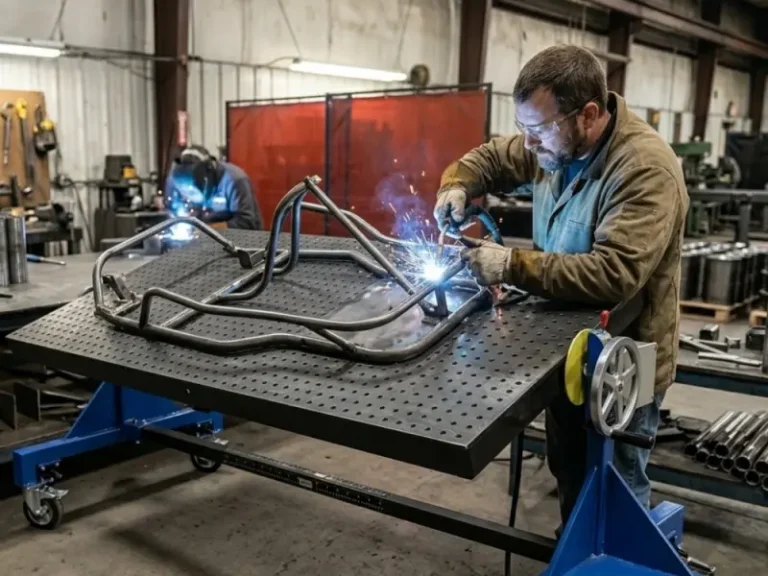
A rotary welding table is one of the simplest ways to improve workpiece positioning during welding. Instead of repeatedly stopping the weld, moving around the component, or manually repositioning a heavy part, the table rotates the workpiece while the welder remains in a more comfortable working position.
Rotary welding tables are widely used for welding pipes, flanges, fittings, tanks, round components, and fabricated assemblies. Depending on the design, the table may provide continuous 360° rotation, adjustable speed, table tilting, and compatibility with welding chucks or custom fixtures.
But rotary welding tables vary significantly in size, capacity, rotation speed, and workholding method.
This guide explains how they work, how they differ from ordinary welding tables and welding rotators, and what specifications you should consider before choosing one.
What Is a Rotary Welding Table?
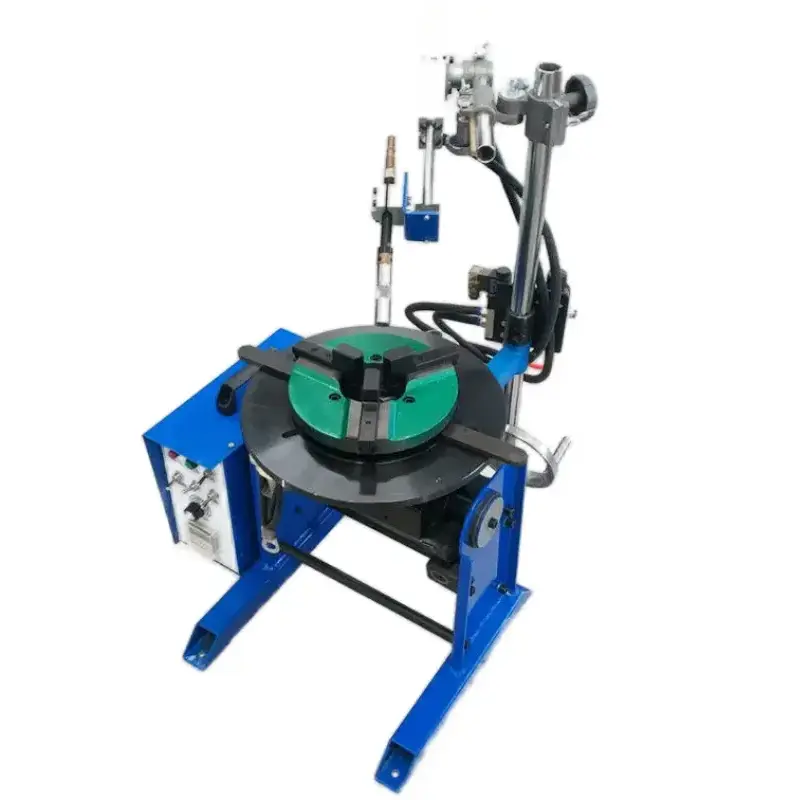
A rotary welding table is a workpiece positioning device with a powered or manually rotating table.
The workpiece is mounted on the table using a welding chuck, faceplate, fixture, or other clamping system. During welding, the table rotates the workpiece around its axis.
On a powered system, rotation speed can be adjusted to match the required welding travel speed.
Many rotary welding tables also allow the table to tilt. This gives the operator two basic movements:
- Rotation — turns the workpiece
- Tilt — changes the workpiece angle
Together, these movements allow the weld joint to be positioned where it is easier for the operator or welding torch to access.
Rotary Welding Table vs Welding Positioner
The terms rotary welding table, welding turntable, and welding positioner are sometimes used interchangeably, but there can be a practical difference in how the terms are used.
A simple rotary welding table may provide only horizontal rotation.
A welding positioner usually provides both:
- 360° workpiece rotation
- Adjustable table tilt
For example, if you only need to rotate a small round component in a horizontal plane, a simple welding turntable may be sufficient.
If you need to rotate a pipe and then tilt it to change the welding angle, a tilting welding positioner provides much greater flexibility.
The correct choice depends on the workpiece and the welds that need to be performed.
How Does a Rotary Welding Table Work?
A typical motorized rotary welding table contains several basic systems.
1. Rotating Table
The workpiece is mounted to a circular table or faceplate.
The table rotates around its central axis and carries the workpiece through the weld.
2. Drive System
An electric motor and reduction mechanism provide controlled table rotation.
The reduction system lowers motor speed and increases torque so that the table can rotate the workpiece smoothly at welding speeds.
3. Speed Control
Variable-speed control allows the operator to adjust table RPM.
Depending on the model, speed may be controlled using:
- Control knob
- Foot pedal
- Hand pendant
- Digital controller
The correct speed depends on the workpiece diameter and required linear welding speed.
4. Tilt Mechanism
On a tilting rotary welding table, the complete table can be inclined to change the orientation of the workpiece.
Compact positioners often use manual tilt adjustment, while larger industrial systems may use powered tilt mechanisms.
5. Workholding System
The workpiece must be securely attached to the rotating table.
Common options include:
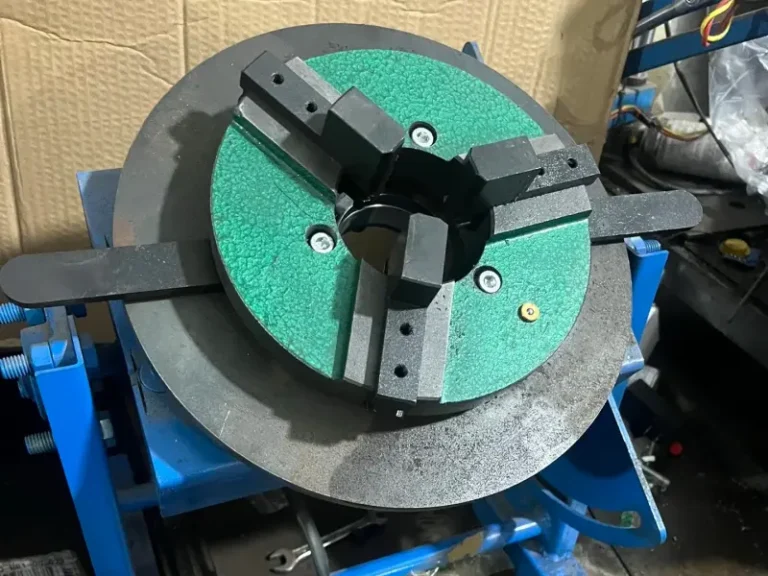
- 3-jaw welding chuck
- Independent-jaw welding chuck
- Faceplate
- Custom fixture
- Bolted clamps
Choosing the right workholding system is just as important as choosing the positioner itself.
Why Use a Rotary Welding Table?
The main purpose of a rotary welding table is not simply to make the workpiece spin.
Its real value is controlling the relationship between the workpiece, weld joint, welding torch, and operator.
Without positioning equipment, a welder may need to stop repeatedly and move around the workpiece.
With a rotary table:
Workpiece rotates → Weld joint moves → Torch position can remain relatively stable
This is particularly useful for circumferential welding.
More Consistent Welding Speed
When welding around a pipe manually, maintaining exactly the same travel speed around the entire circumference can be difficult.
A motorized rotary table provides controlled rotational speed.
Once the appropriate speed is established, the workpiece can rotate at a consistent rate throughout the weld.
Better Welding Position
A rotary welding table can help place the weld in a more favorable orientation.
Instead of requiring the operator to weld around the complete circumference of a fixed component, the workpiece can rotate beneath the welding torch.
When a tilting positioner is used, the table angle can also be adjusted to improve access to the joint.
Less Manual Repositioning
Heavy or awkward components may require repeated lifting, turning, clamping, and repositioning.
A welding positioner reduces these manual handling steps because the workpiece remains attached to the rotating table.
This is particularly useful for repetitive production.
Easier Welding Automation
Rotary welding tables can also form the foundation of a simple mechanized welding system.
For example:
Fixed Welding Torch + Rotary Welding Table + Controlled Rotation
can provide a practical setup for repetitive circumferential welds.
More advanced systems may integrate the positioner with a welding controller, torch stand, manipulator, PLC, or robotic welding system.
Types of Rotary Welding Tables
Rotary welding tables can be divided broadly into three categories.
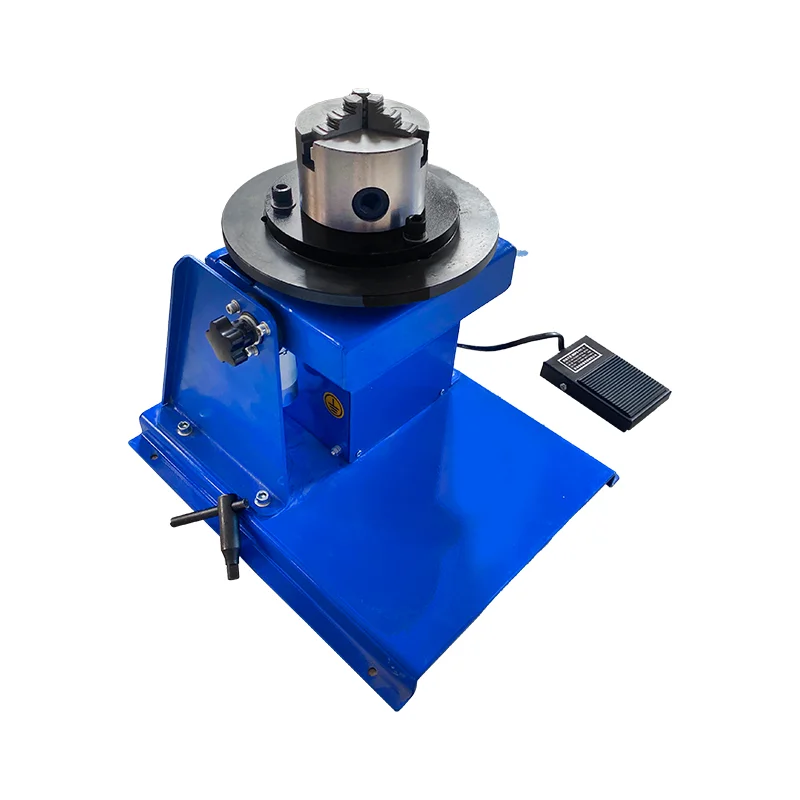
Benchtop Rotary Welding Tables
Compact benchtop models are designed for small components and workshop applications.
Typical workpieces include:
- Small pipes
- Tubes
- Flanges
- Fittings
- Bushings
- Automotive components
- Small fabricated assemblies
Their compact size makes them particularly suitable for TIG and small-component welding.
MECBASE compact welding positioners are available in capacities such as 10 kg, 30 kg, and 50 kg for these applications.
Medium-Duty Welding Positioners
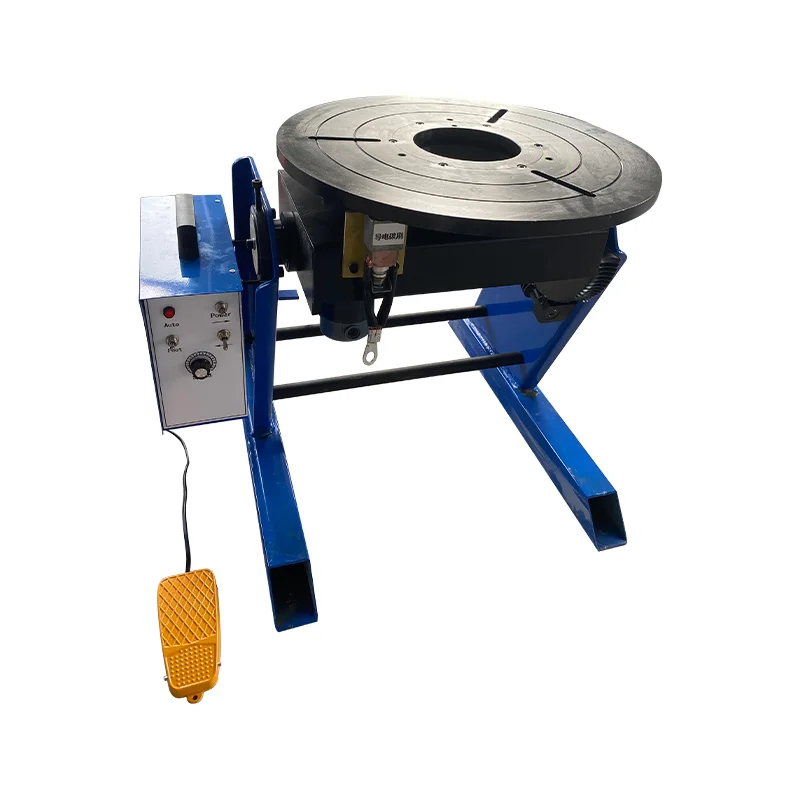
As workpiece weight and diameter increase, larger tables, stronger gearboxes, and more powerful drive systems are required.
Medium-duty positioners are commonly used for:
- Larger pipes
- Flanges
- Valve components
- Structural assemblies
- Small tanks
- Pressure equipment components
These machines may also accommodate larger welding chucks and custom fixtures.
Heavy-Duty Rotary Welding Tables
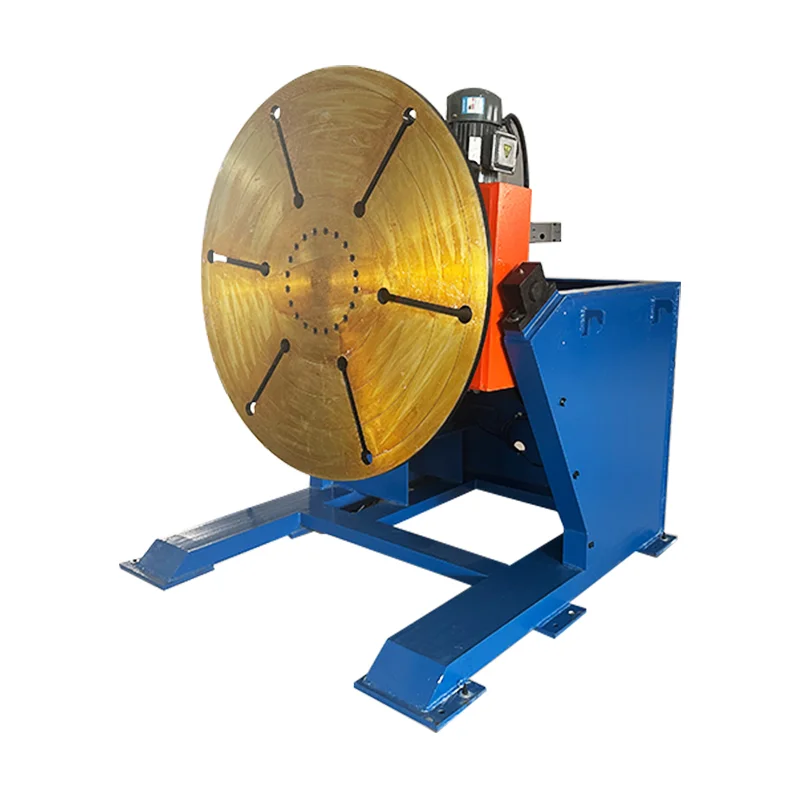
Heavy-duty positioners are designed for large industrial workpieces.
Applications can include:
- Pressure vessels
- Heavy pipe assemblies
- Large structural components
- Industrial machinery
- Large fabricated weldments
At this level, workpiece weight alone is not sufficient for equipment selection. Center of gravity, eccentric load, overturning moment, and tilt torque become increasingly important.
How to Choose a Rotary Welding Table
Several specifications should be evaluated together.
1. Load Capacity
Start with the total rotating load.
This includes more than the workpiece itself:
Total Load = Workpiece + Chuck + Fixture + Adapter Plate
For example, if a workpiece weighs 35 kg and the chuck weighs 8 kg, the positioner is already carrying at least 43 kg before any additional fixture is considered.
Therefore, a positioner should not be selected simply because its nominal capacity matches the workpiece weight.
2. Center of Gravity
This is one of the most frequently overlooked factors when selecting a welding positioner.
A 40 kg compact workpiece positioned close to the table is very different from a 40 kg long pipe extending far away from the table.
As the center of gravity moves farther from the table or rotation axis, the load creates a larger moment.
This becomes particularly important when the table is tilted.
For long, eccentric, or irregular workpieces, always consider both weight and center of gravity.
3. Table Diameter
The table must provide an appropriate mounting surface for the chuck or fixture.
A larger workpiece does not necessarily require a table as large as the workpiece itself, because the component may be held using a chuck or adapter plate.
However, the mounting interface must remain mechanically suitable for the load.
Check:
- Table diameter
- Mounting holes
- Bolt circle
- Center bore
- Chuck mounting dimensions
4. Rotation Speed
Rotational speed should be selected according to the required welding travel speed and workpiece diameter.
A useful relationship is:
Rotational Speed (RPM) = Welding Travel Speed ÷ Workpiece Circumference
Since:
Circumference = π × Diameter
a larger-diameter workpiece requires a lower RPM to achieve the same linear welding speed.
This is why very small components may require relatively high RPM, while large pipes and vessels require much slower rotation.
Stepless speed adjustment is particularly useful when the same positioner handles multiple workpiece diameters.
5. Tilt Angle
If the table only needs to rotate horizontally, a simple welding turntable may be sufficient.
If the workpiece must also be angled to improve access to the weld, choose a tilting welding positioner.
Common positioners allow the table to move from approximately:
0° → 90°
Some industrial designs provide a wider range.
The required tilt range should be based on the actual weld joint locations rather than simply choosing the machine with the largest possible angle.
Choosing the Right Welding Chuck
A rotary welding table needs an appropriate workholding system.
For round components, a welding chuck is often the most convenient solution.
3-Jaw Welding Chuck
A 3-jaw chuck for a welding positioner is particularly useful for repetitive clamping of round components.
Typical applications include:
- Pipe
- Tube
- Flange
- Fittings
- Rings
- Cylindrical parts
A self-centering mechanism allows the jaws to move together, making setup relatively fast for round workpieces.
Independent-Jaw Welding Chuck
Independent jaws can be adjusted individually.
This takes longer to set up but provides greater flexibility for:
- Irregular workpieces
- Eccentric parts
- Components requiring manual centering
- Larger fabricated assemblies
For fabrication shops handling many different workpiece geometries, independent adjustment can be more useful than fast self-centering.
Faceplate and Custom Fixtures
Not every workpiece can be held in a chuck.
Square, rectangular, highly irregular, or large fabricated components may need to be bolted or clamped directly to a faceplate.
Custom fixtures are also common in repetitive manufacturing where the same component is produced in large quantities.
Internal vs External Chuck Clamping
Round workpieces can often be held in two ways.
External Clamping
The jaws grip the outside diameter of the component.
This is common for:
- Pipes
- Tubes
- Round bars
- Cylindrical components
Internal Clamping
The jaws expand against an internal diameter.
This can be useful for:
- Flanges
- Rings
- Large pipe openings
- Sleeves
Internal clamping can leave more of the outside surface accessible for welding.
The appropriate method depends on workpiece geometry and weld location.
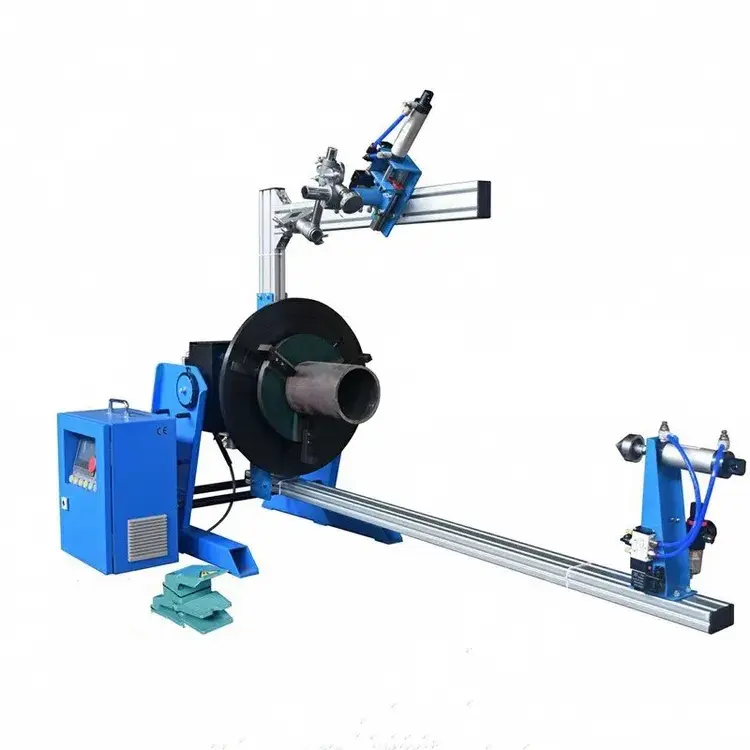
Rotary Welding Table for Pipe Welding
Pipe welding is one of the most common applications for rotary welding tables.
A typical setup is:
Welding Positioner → Welding Chuck → Pipe → Welding Torch
The chuck holds and centers the pipe.
The positioner rotates it.
The welding torch remains in the required position.
This configuration can be used for:
- Pipe-to-pipe welding
- Pipe-to-flange welding
- Pipe-to-fitting welding
- Circumferential welds
- Tube fabrication
- Valve and fitting production
For long pipes, additional support may be necessary to prevent excessive cantilever load.
Roller stands or other supporting equipment can be used while allowing the pipe to rotate.
Rotary Welding Table for TIG Welding
Small rotary positioners are particularly useful for TIG welding because TIG often benefits from stable and controlled travel speed.
Typical applications include:
- Stainless steel tubing
- Thin-wall pipe
- Exhaust components
- Instrument tubing
- Small pressure components
- Precision circular welds
The operator can concentrate on arc length, torch angle, filler addition, and weld pool control while the positioner controls workpiece rotation.
Rotary Welding Table for MIG/MAG Welding
Rotary positioners can also be used with MIG/MAG welding.
The combination is useful for repetitive fabrication where the same circular weld is performed repeatedly.
Once suitable parameters are established, the system can maintain a consistent relationship between wire feed, welding travel speed, and workpiece rotation.
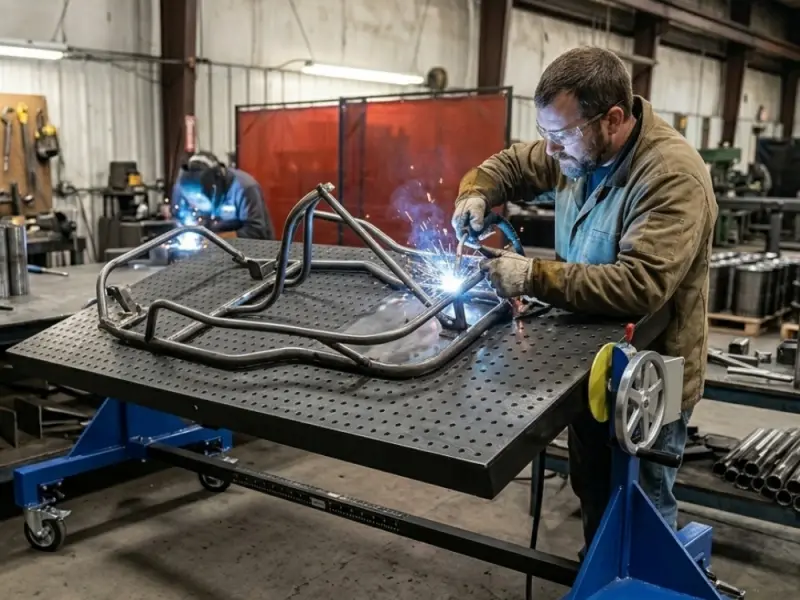
Rotary Welding Table vs Flat Welding Table
Despite their similar names, these machines perform very different jobs.
| Rotary Welding Table | Flat Welding Table |
| Rotates the workpiece | Workpiece remains stationary |
| May provide tilt | No powered tilt |
| Used during welding | Often used for fit-up and assembly |
| Motorized rotation available | No rotation mechanism |
| Can hold a welding chuck | Uses clamps and fixtures |
| Useful for circumferential welds | Useful for general fabrication |
Many fabrication shops use both.
The flat table is used to assemble and tack components, while the rotary positioner is used when controlled workpiece movement improves the final welding operation.
Rotary Welding Table vs Welding Rotator
These two types of equipment also rotate workpieces, but in different ways.
| Rotary Welding Table | Welding Rotator |
| Workpiece mounted to table/chuck | Workpiece supported on rollers |
| Suitable for many workpiece shapes | Mainly cylindrical workpieces |
| Rotation + tilt possible | Rotation only |
| Good for pipes, flanges and fittings | Good for tanks, vessels and long pipes |
| Compact models available | Generally requires more floor space |
| Workpiece may be cantilevered | Workpiece supported along its diameter |
For smaller pipes, fittings, and general assemblies, a welding positioner is often the more flexible choice.
For large tanks and long cylindrical vessels, a welding rotator is generally more appropriate.
Rotary Welding Table vs Welding Manipulator
A welding positioner and welding manipulator perform different functions.
The positioner moves the workpiece.
The manipulator moves the welding torch.
In an automated welding system, the two machines may work together.
For example:
- Welding Manipulator → Positions Torch
- Rotary Welding Table → Rotates Workpiece
Together they can control both sides of the welding operation.
Do Not Ignore Welding Current Grounding
A rotary welding system must provide an appropriate welding-current return path.
Allowing welding current to pass unintentionally through rotating bearings can cause electrical arcing and damage bearing surfaces.
For this reason, the welding setup should use a suitable grounding arrangement designed to provide a low-resistance return path while the table rotates.
This detail becomes particularly important in repetitive production where the positioner operates for long periods.
When Should You Use a Rotary Welding Table?
A rotary welding table is worth considering when:
- You frequently weld round components
- The workpiece needs repeated manual repositioning
- Circumferential welds are common
- Consistent rotation speed is important
- The operator needs better access to the weld
- You want to reduce unnecessary workpiece handling
- You plan to introduce mechanized or automated welding
- You repeatedly produce similar welded components
The more repetitive the welding operation, the greater the potential benefit of controlled positioning.
What Size Rotary Welding Table Do I Need?
A simple starting point is to identify:
- Maximum workpiece weight
- Chuck or fixture weight
- Workpiece diameter
- Workpiece length
- Center-of-gravity distance
- Required rotation speed
- Required tilt angle
- Welding process
For example, selecting a 50 kg welding positioner does not necessarily mean that every 50 kg workpiece is suitable.
A long 40 kg pipe mounted horizontally may impose a greater mechanical load than a compact 50 kg component centered directly above the table.
For this reason, equipment selection should consider the complete workpiece geometry rather than rated capacity alone.
Choose the Right Rotary Welding Table for Your Application
The best rotary welding table is not necessarily the model with the highest load capacity or largest table.
The correct system depends on how the workpiece will actually be welded.
Consider the complete setup:
Workpiece + Welding Chuck/Fixture + Positioner + Welding Process
For small pipes, fittings, flanges, and precision welding, a compact benchtop welding positioner may be sufficient.
For heavier components, larger tables and higher torque are required.
For long tanks and large cylindrical vessels, a welding rotator may be a better solution than a table-type positioner.
MECBASE provides welding positioners, rotary welding tables, welding chucks, and welding rotators for different fabrication requirements. By providing your workpiece dimensions, weight, welding process, and required movement, you can select a positioning system that matches the actual welding application.
Frequently Asked Questions
In some cases, yes. An adapter plate can be used when the mounting dimensions are compatible. However, chuck weight, workpiece weight, center of gravity, and the resulting moment must remain within the positioner's allowable limits.
Yes, but long pipes usually require additional support. Roller stands or similar supports can reduce cantilever load while allowing the pipe to rotate.
Not necessarily, but a foot pedal is convenient for manual welding because the operator can start or stop rotation without removing a hand from the welding operation.
Many powered welding positioners provide forward and reverse rotation. This is useful when different weld directions or workpiece setups are required.
Yes. A rotary positioner can be combined with a fixed torch stand, manipulator, welding controller, or automated welding system for repetitive circular welding.
Choose a chuck when the workpiece is round and falls within the chuck's clamping range. A faceplate or custom fixture is usually more suitable for irregular, square, eccentric, or unusually large components.