Wire rope is one of the most widely used lifting and rigging components in industrial, marine, construction, and offshore applications. It is a flexible, high-strength rope made from multiple strands of steel wire twisted together to form a strong, durable lifting line.
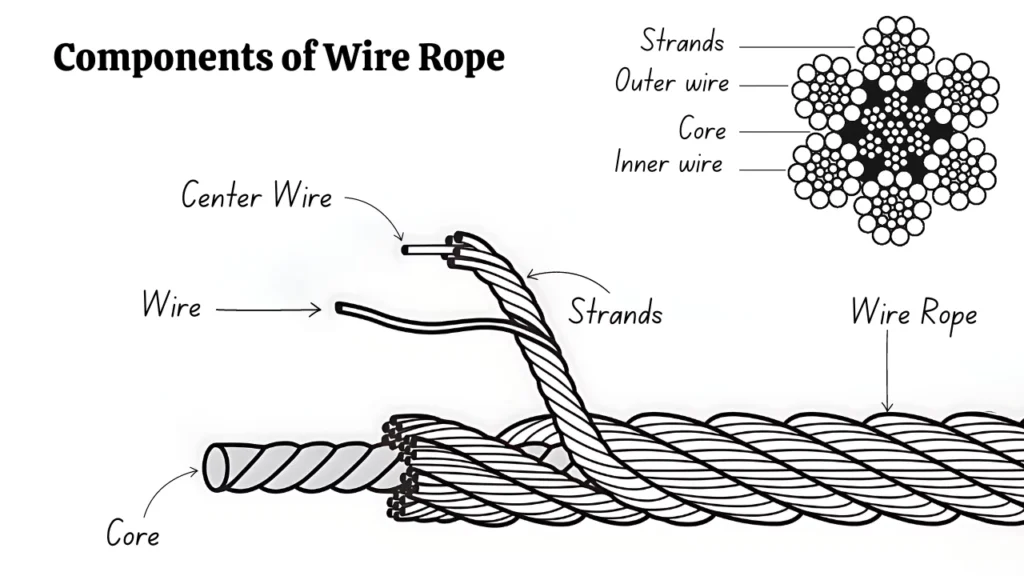
What Is Wire Rope?
Wire rope is essentially a collection of individual steel wires twisted into strands, which are then laid around a core. The core can be made of:
- Fiber (natural or synthetic)
- Steel wire
- Independent Wire Rope Core (IWRC)
The design provides:
- Tensile strength
- Flexibility
- Resistance to wear
- Fatigue resistance
Wire rope is used in:
- Cranes and hoists
- Rigging systems
- Elevator systems
- Cable cars and funiculars
- Mining and offshore operations
Wire Rope Construction
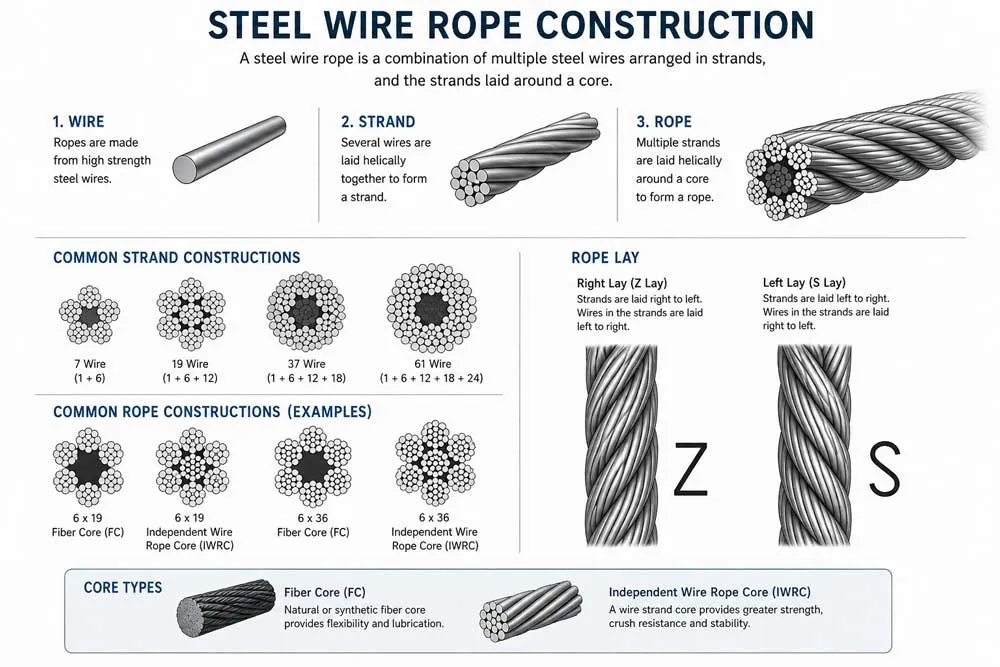
Wire rope construction is defined by three main factors:
Number of Strands
Wire rope is composed of multiple strands twisted around the core. Common configurations include:
| Strands | Wires per Strand | Common Use |
| 6 × 19 | 6 strands × 19 wires | General purpose lifting, flexible |
| 6 × 37 | 6 strands × 37 wires | Higher flexibility, rope can bend around smaller sheaves |
| 8 × 19 | 8 strands × 19 wires | Offshore or high-strength applications |
| 6 × 7 | 6 strands × 7 wires | Heavy-duty, low-flex rope |
Core Type
The core supports the rope and maintains its shape.
| Core Type | Description | Advantages |
| Fiber Core (FC) | Natural or synthetic fiber | Provides flexibility and shock absorption |
| Independent Wire Rope Core (IWRC) | Steel wire core | Higher strength and crushing resistance |
| Wire Strand Core | A smaller wire strand | Balanced flexibility and strength |
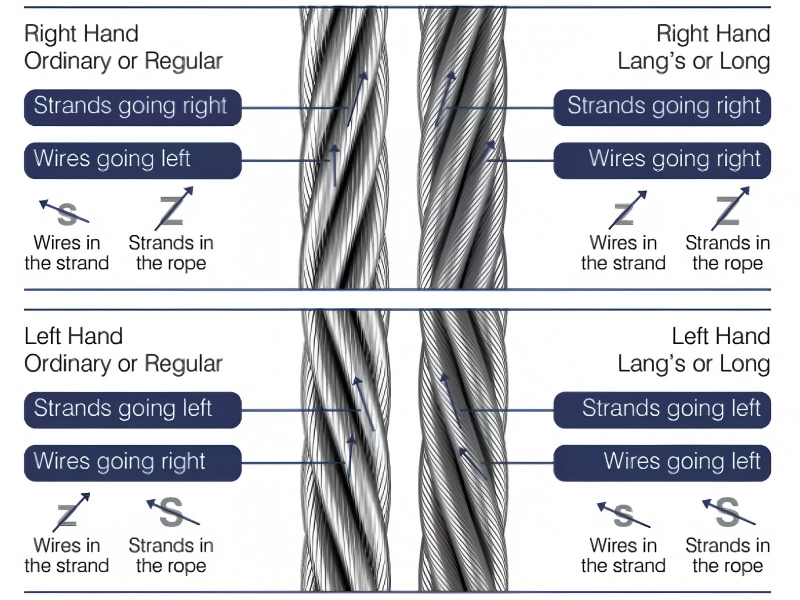
Lay Direction
The way the wires and strands are twisted affects rope behavior.
- Right-Hand Lay: Strands twist clockwise around the core.
- Left-Hand Lay: Strands twist counterclockwise around the core.
- Regular Lay: Wires in a strand twist opposite to the strand twist around the core. Most common.
- Lang Lay: Wires twist in the same direction as the strands. More flexible, but more prone to wear on sheaves.
Wire Rope Specifications
When selecting wire rope, several key specifications are critical:
| Specification | Description |
| Diameter | Rope thickness (inches or mm) |
| Construction | Number of strands × wires per strand (e.g., 6 × 19) |
| Material | Carbon steel, stainless steel, galvanized steel |
| Core Type | Fiber, IWRC, or wire strand |
| Lay Direction | Right-hand or left-hand |
| Breaking Strength | Maximum tensile load rope can handle |
| Safety Factor | Ratio of breaking strength to working load limit |
| Coating | Galvanized or bare wire |
| Rope Class | Standardized classification per ISO, ASTM, or EN |
Common Wire Rope Types
1. Standard Lifting Wire Rope
- Material: Carbon steel or alloy steel
- Use: Cranes, hoists, general lifting
- Construction: 6 × 19 or 6 × 37
2. Stainless Steel Wire Rope
- Material: Stainless steel 304 / 316
- Use: Marine, offshore, corrosive environments
- Feature: Corrosion resistant
3. Galvanized Wire Rope
- Material: Zinc-coated carbon steel
- Use: Outdoor lifting, moderate corrosion protection
- Feature: Longer service life in general conditions
4. Elevator Wire Rope
- Material: High-strength steel
- Feature: Low stretch
- Use: Vertical transportation systems
Safety Considerations
- Never exceed Working Load Limit (WLL).
- Inspect ropes regularly for:
- Broken wires
- Corrosion
- Crushing
- Kinks or birdcaging
- Choose correct rope construction for application:
- Flexible for sheave or pulleys
- Extra strength for straight lifts
- Follow standards:
- ASME B30.9
- ISO 2408
- EN 12385
- OSHA rigging regulations
Summary
Wire rope is a versatile and critical component in lifting and rigging operations. Understanding its construction, lay, material, core type, and specifications ensures safe and efficient lifting performance.
Selecting the correct wire rope involves:
- Choosing the proper diameter and construction.
- Matching core type to application.
- Ensuring breaking strength and WLL meet load requirements.
- Accounting for environmental conditions (corrosion, temperature, abrasion).
FAQs About Wire Rope
Wire rope is made of multiple steel wires twisted into strands, which are then wrapped around a central core. The rope may be manufactured from carbon steel, galvanized steel, or stainless steel depending on the application and environment.
The first number represents the number of strands, while the second number represents the approximate number of wires in each strand.
For example:
- 6×19 = 6 strands with approximately 19 wires per strand
- 6×37 = 6 strands with approximately 37 wires per strand
Generally, more wires provide greater flexibility but lower abrasion resistance.
IWRC stands for Independent Wire Rope Core.
An IWRC consists of a separate steel wire rope used as the core, providing:
- Higher strength
- Better crushing resistance
- Improved support for the outer strands
IWRC ropes are commonly used for crane and lifting applications.
| Core Type | Advantages |
| Fiber Core (FC) | More flexible, better shock absorption |
| IWRC (Steel Core) | Higher strength, greater crushing resistance |
Fiber core ropes are often used for general-purpose applications, while IWRC ropes are preferred for heavy lifting.
Wire rope lay describes the direction in which the wires and strands are twisted.
Common types include:
- Right Regular Lay
- Left Regular Lay
- Right Lang Lay
- Left Lang Lay
Lay direction affects flexibility, wear characteristics, and handling.
Breaking strength is the maximum load a new wire rope can withstand before failure under laboratory conditions.
It is not the same as the Working Load Limit (WLL), which includes a safety factor.
Galvanized Wire Rope
- Zinc-coated steel
- Good corrosion resistance
- Cost-effective
Stainless Steel Wire Rope
- Superior corrosion resistance
- Suitable for marine and offshore environments
- Higher cost
Wire rope should be inspected:
- Before each use
- During scheduled maintenance
- After shock loading events
Inspect for:
- Broken wires
- Corrosion
- Crushing
- Kinks
- Birdcaging
- Excessive wear
Birdcaging occurs when the strands separate and bulge outward, creating a cage-like appearance.
It is typically caused by:
- Sudden unloading
- Improper handling
- Excessive twisting
A birdcaged rope should be removed from service.
Wire rope is widely used in:
- Construction
- Oil & Gas
- Offshore operations
- Mining
- Marine applications
- Cranes and hoists
- Elevators
- Material handling systems
Because of its strength and flexibility, wire rope remains one of the most important components in lifting and rigging operations worldwide.