Tower cranes are among the most important lifting machines used in modern construction. Their ability to lift heavy materials to significant heights while maintaining excellent stability makes them essential for high-rise buildings, industrial facilities, bridges, power plants, and infrastructure projects.
This guide explains tower crane terminology, components, operating principles, classifications, safety systems, and selection criteria to help contractors, engineers, project managers, and equipment buyers make informed decisions.
What Is a Tower Crane?
A tower crane is a slewing crane with a vertical tower structure designed to lift and move materials both vertically and horizontally across a job site.
Tower cranes are widely used because they offer:
- Exceptional lifting height
- Large working radius
- High load capacity
- Precise positioning
- Continuous operation capability
They serve as the primary lifting equipment on many construction and industrial projects.

Key Advantages of Tower Cranes
High Lifting Height
Tower cranes can reach heights of hundreds of feet, making them ideal for high-rise construction.
Large Working Radius
The extended jib allows materials to be transported across large construction sites.
Efficient Material Handling
Tower cranes can simultaneously perform vertical lifting and horizontal transportation.
Stable and Reliable Operation
Advanced structural design and counterweight systems ensure operational stability.
Limitations of Tower Cranes
- Large transportation requirements
- Complex assembly and dismantling
- Significant foundation requirements
- Dependence on trained operators
- Higher installation costs compared to mobile cranes
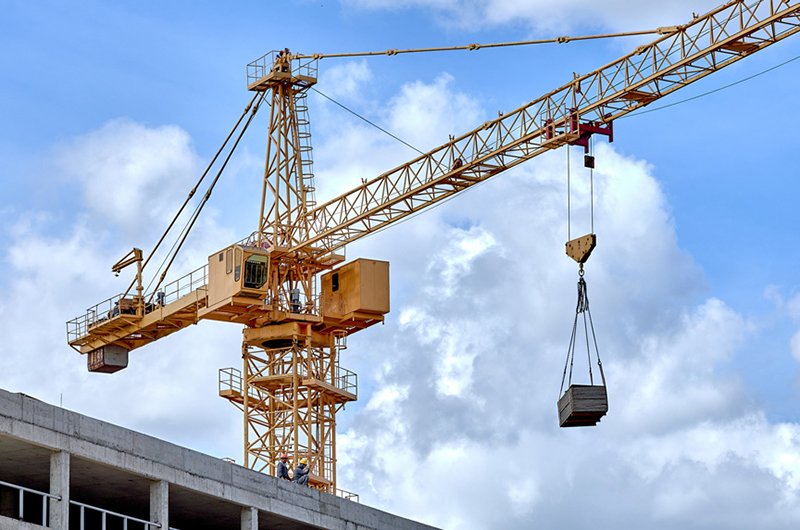
Basic Tower Crane Terminology
Understanding key tower crane terminology is essential for safe operation and equipment selection.
Tower
The vertical structural framework that supports the crane.
Jib
The horizontal working arm used to position loads.
Counterjib
The arm opposite the jib that supports counterweights and machinery.
Load Radius
The horizontal distance between the crane’s rotation center and the load.
Slewing
The rotational movement of the crane superstructure.
Sheave
A grooved wheel used to guide wire rope.
Load Block
The hook assembly containing sheaves, pins, swivels, and frame components.
Rotation-Resistant Rope
A specially designed wire rope that minimizes twisting during lifting operations.
Cab
The operator station containing crane controls and monitoring equipment.
Core Components of a Tower Crane
A tower crane consists of three major systems:
1. Metal Structure (The Skeleton)
- The structural framework provides strength and stability.
- Tower Mast
- The vertical support structure made from modular tower sections.
- Jib
- The primary horizontal lifting arm.
- Counterjib
- Supports counterweights and mechanical equipment.
- Base
- Transfers loads safely to the foundation.
2. Operating Mechanisms (The Muscles)
- Hoisting Mechanism
- Controls lifting and lowering operations.
- Trolley Mechanism
- Moves the load horizontally along the jib.
- Luffing Mechanism
- Changes the working radius by raising or lowering the boom.
- Slewing Mechanism
- Rotates the crane around its vertical axis.
- Traveling Mechanism
- Allows mobile tower cranes to move around a site.
3. Electrical and Control Systems (The Brain)
- Control Systems
- Operator controls
- Touchscreen displays
- Emergency stop systems
- Monitoring Systems
- Load moment indicators
- Wind speed sensors
- Height limiters
- Anti-collision systems
How Tower Cranes Work
The operating principle of a tower crane is based on torque balance.
Rated Torque Principle
The fundamental relationship is:
Lifting Capacity × Working Radius = Rated Torque
This means:
- As load weight increases, allowable working radius decreases.
- As working radius increases, allowable load decreases.
Operators must always follow the crane’s load chart.
Load Movement Process
Tower cranes coordinate multiple mechanisms simultaneously:
- Step 1: Hoisting
- The load is lifted vertically.
- Step 2: Trolleying or Luffing
- The load radius is adjusted.
- Step 3: Slewing
- The crane rotates toward the destination.
- Step 4: Lowering
- The load is placed precisely at the target location.
Main Types of Tower Cranes
By Slewing Location
Top-Slewing Tower Crane
The most common design.
Advantages:
- Greater lifting height
- Better load capacity
- Suitable for high-rise projects
Bottom-Slewing Tower Crane
The entire crane rotates at the base.
Advantages:
- Compact design
- Easier installation
- Lower operating height
By Jib Configuration
Hammerhead Tower Crane
Features a horizontal jib and traveling trolley.
Advantages:
- Efficient material handling
- Large coverage area
- Popular in high-rise construction
Luffing Jib Tower Crane
Uses a boom that changes angle.
Advantages:
- Reduced swing radius
- Ideal for congested urban projects
- Higher tip load capability
By Mobility
Fixed Tower Crane
Installed on a permanent foundation.
Rail-Mounted Tower Crane
Moves along rails.
Mobile Tower Crane
Mounted on wheels or crawler systems.
By Installation Method
Freestanding Tower Crane
Operates without external supports.
Internal Climbing Tower Crane
Installed within a building structure and climbs as construction progresses.
Self-Erecting Tower Crane
Hydraulically erects itself for rapid deployment.
Permanently Mounted Tower Crane
Installed for long-term operation at a single site.
How to Select the Right Tower Crane
Step 1: Determine Load Requirements
Consider:
- Maximum load weight
- Typical load weight
- Rigging weight
Step 2: Calculate Required Radius
Determine the maximum distance from crane center to the farthest lifting point.
Step 3: Calculate Required Height
Required Hook Height = Building Height + Clearance + Safety Margin
Step 4: Evaluate Site Conditions
Factors include:
- Available space
- Ground bearing capacity
- Nearby structures
- Power line clearance
- Wind conditions
Step 5: Analyze Costs
Consider:
- Crane rental or purchase
- Transportation
- Foundation construction
- Installation and dismantling
- Maintenance
Tower Crane Safety Precautions
Safety is the most critical aspect of tower crane operations.
Daily Inspection Requirements
Inspect:
- Wire ropes
- Hooks
- Limit switches
- Bolts
- Braking systems
Operator Requirements
Only trained and certified personnel should operate tower cranes.
Weather Restrictions
Operations should stop during:
- High winds
- Thunderstorms
- Severe weather conditions
Load Management
Never exceed the manufacturer’s rated load chart.
Essential Tower Crane Safety Devices
Load Moment Indicator (LMI)
Monitors crane loading conditions in real time.
Anti Two-Block Device
Prevents hook block collisions.
Wind Speed Indicator
Provides real-time wind monitoring.
Limit Switches
Prevent excessive movement.
Anti-Collision System
Protects cranes operating in shared airspace.
Emergency Stop System
Immediately cuts power during emergencies.
Aviation Obstruction Lights
Required for tall tower cranes to ensure aircraft visibility.
Applications of Tower Cranes
Tower cranes are commonly used in:
High-Rise Construction
- Residential towers
- Office buildings
- Hotels
Infrastructure Projects
- Bridges
- Airports
- Rail systems
Industrial Facilities
- Refineries
- Petrochemical plants
- Manufacturing facilities
Energy Projects
- Power plants
- Wind farms
- LNG facilities
Conclusion
Tower cranes remain one of the most important lifting solutions in modern construction and industrial projects. Understanding tower crane terminology, structure, operating principles, safety requirements, and selection criteria helps improve productivity, reduce risk, and ensure successful project execution.
Choosing the right tower crane requires balancing lifting capacity, working radius, site conditions, safety requirements, and project economics.
FAQs About Tower Cranes
Tower cranes use hydraulic climbing systems that insert additional mast sections into the tower structure as the building rises.
Capacity varies by model and configuration. Modern tower cranes can lift from several tons to over 100 tons depending on radius.
Tower cranes rely on engineered foundations, counterweights, tie-ins, load moment indicators, and strict operating procedures.
No. Operations must stop when wind speeds exceed manufacturer limits.
Daily inspections should be conducted before operation, with regular detailed inspections performed according to local regulations and manufacturer requirements.