Remote control lawn mowers are becoming an increasingly practical solution for vegetation management on slopes, rough terrain, orchards, solar farms, roadside embankments, and other areas where conventional mowing equipment can be difficult to operate.
Unlike a riding mower, a remote control mower allows the operator to control the machine from a distance. This can improve accessibility and reduce the need for an operator to ride directly on a machine working in challenging terrain.
But remote control mowers come in many different designs. Understanding the differences in undercarriage, cutting system, powertrain, and slope capability is essential when choosing the right machine.
This guide covers the basics.
What Is a Remote Control Lawn Mower?
A remote control lawn mower, also known as an RC lawn mower or remote controlled mower, is a mowing machine operated through a wireless remote controller.
Depending on the model, the operator can typically control:
- Forward and reverse movement
- Steering
- Travel speed
- Cutting system
- Engine start and stop
- Emergency stop
The operator does not need to walk directly behind the mower or sit on the machine.
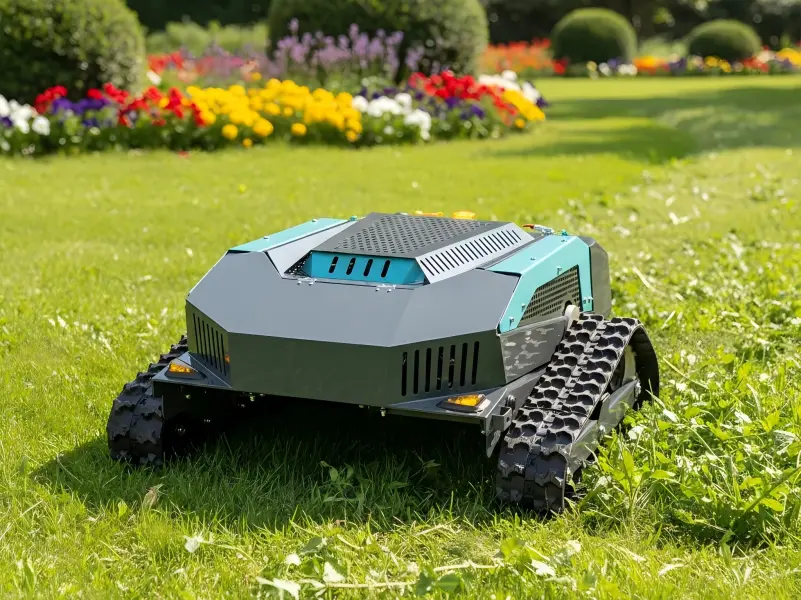
This makes remote control mowers particularly useful for difficult terrain, slopes, dense vegetation, and areas with limited access.
How Does a Remote Control Lawn Mower Work?
Most remote control mowers combine four basic systems.
Power System
Power may come from a gasoline engine, diesel engine, battery-electric system, or a combination of engine and electric drive.
A common hybrid configuration uses an engine to power the cutting deck while electric motors drive the tracks or wheels.
Drive System
Remote control mowers are generally either tracked or wheeled.
Tracked machines provide a larger ground-contact area and are commonly used on slopes, loose ground, and rough terrain.
Wheeled machines can offer efficient movement on firmer and relatively level surfaces.
Cutting System
Two common cutting systems are:
Rotary mower: Uses horizontally rotating blades and is generally suitable for grass and routine vegetation maintenance.
Flail mower: Uses multiple swinging blades mounted on a rotating rotor and is typically better suited to tall grass, dense weeds, and rough vegetation.
Remote Control System
A wireless transmitter communicates with the receiver installed on the mower, allowing the operator to control movement and mowing functions from a distance.
Remote control range varies by machine and should always be evaluated together with the manufacturer’s recommended safe operating practices.
Main Types of Remote Control Lawn Mowers
Although there are many designs available, most remote control mowers fall into several broad categories.
Tracked Remote Control Mower
A tracked remote control mower uses rubber tracks instead of conventional tires.
Tracks can provide better traction and a larger contact area on loose, uneven, or sloped ground.
They are commonly used for:
- Slopes
- Orchards
- Rough terrain
- Solar farms
- Roadside vegetation
However, tracks alone do not determine slope capability. Machine width, center of gravity, weight distribution, track geometry, and drive system are also important.
Wheeled Remote Control Mower
Wheeled models are often suitable for firmer and relatively level terrain.
They can provide lower rolling resistance and efficient travel where the additional traction of tracks is unnecessary.
The choice between a tracked and wheeled mower should therefore depend on the actual working environment.
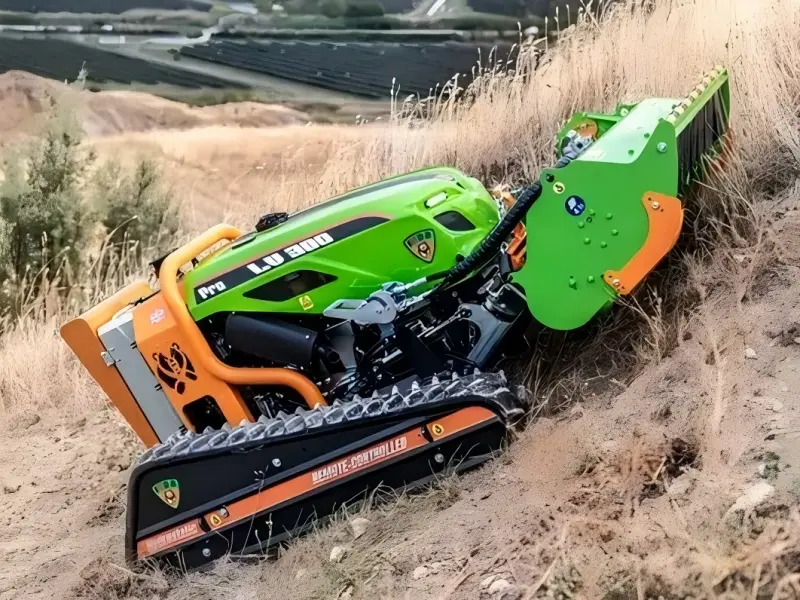
Remote Control Flail Mower
A remote control flail mower is designed for more demanding vegetation management.
Its rotating flail system can be particularly useful for tall grass, weeds, orchards, overgrown land, and some types of light brush.
For maintained grass, however, a simpler rotary mower may be more practical.
Remote Control Slope Mower
A remote control slope mower is designed specifically for inclined terrain.
Typical design considerations include:
- Low center of gravity
- Wide stance
- Strong traction
- Effective braking
- Stable weight distribution
- Remote emergency stop
These machines are commonly used on highway embankments, riverbanks, levees, solar farms, reservoirs, and hilly agricultural land.
Rotary vs Flail: Which Cutting System Is Better?
Neither cutting system is best for every application.
| Application | Rotary | Flail |
| Regular grass | Excellent | Good |
| Tall grass | Good | Excellent |
| Dense weeds | Moderate | Excellent |
| Fine lawn finish | Better | Moderate |
| Rough vegetation | Moderate | Better |
| Mechanical simplicity | Better | More complex |
For routine grass cutting, a rotary mower is often sufficient.
For tall grass, weeds, and heavier vegetation, a flail mower may provide better performance.
The right choice depends primarily on what needs to be cut.
Where Are Remote Control Lawn Mowers Used?
One of the main advantages of remote control mowing equipment is its ability to work in areas where conventional machines may be less practical.
Steep Slopes and Embankments
Slope mowing is one of the most common applications.
Remote operation allows the operator to remain away from the mower rather than riding directly on a machine working on an incline.
Typical locations include highway embankments, riverbanks, levees, reservoirs, and drainage areas.
Orchards and Vineyards
Orchards may have narrow rows, uneven ground, slopes, and vegetation growing between trees.
Compact remote control mowers can provide an alternative where larger tractors or riding mowers have limited access.
Solar Farms
Vegetation around ground-mounted solar panels requires regular management.
Remote control mowers can work between panel rows and across uneven terrain, provided the machine dimensions and cutting system are appropriate.
Machine width, overall height, turning capability, and ground clearance are particularly important for this application.
Roadside and Overgrown Land
Remote control mowers can also be used for roadside vegetation, vacant land, tall grass, and areas that have not been regularly maintained.
For heavier vegetation, a flail or heavy-duty cutting system may be required.
How Steep a Slope Can a Remote Control Mower Handle?
Slope capability is one of the most important specifications—and one of the easiest to misunderstand.
Manufacturers may advertise maximum slope ratings of 30°, 40°, 45°, or more.
However:
Maximum slope capability is not necessarily the same as recommended continuous working slope.
Actual performance depends on factors including:
- Ground conditions
- Wet or dry vegetation
- Soil type
- Direction of travel
- Machine center of gravity
- Track or tire grip
- Operating speed
When comparing machines for professional slope work, ask the supplier for both the maximum slope capability and the recommended continuous working slope.
Real operating videos under representative mowing conditions can also provide useful additional information.
Key Specifications to Compare
Engine horsepower is important, but it should not be the only specification used to compare remote control lawn mowers.
Pay attention to:
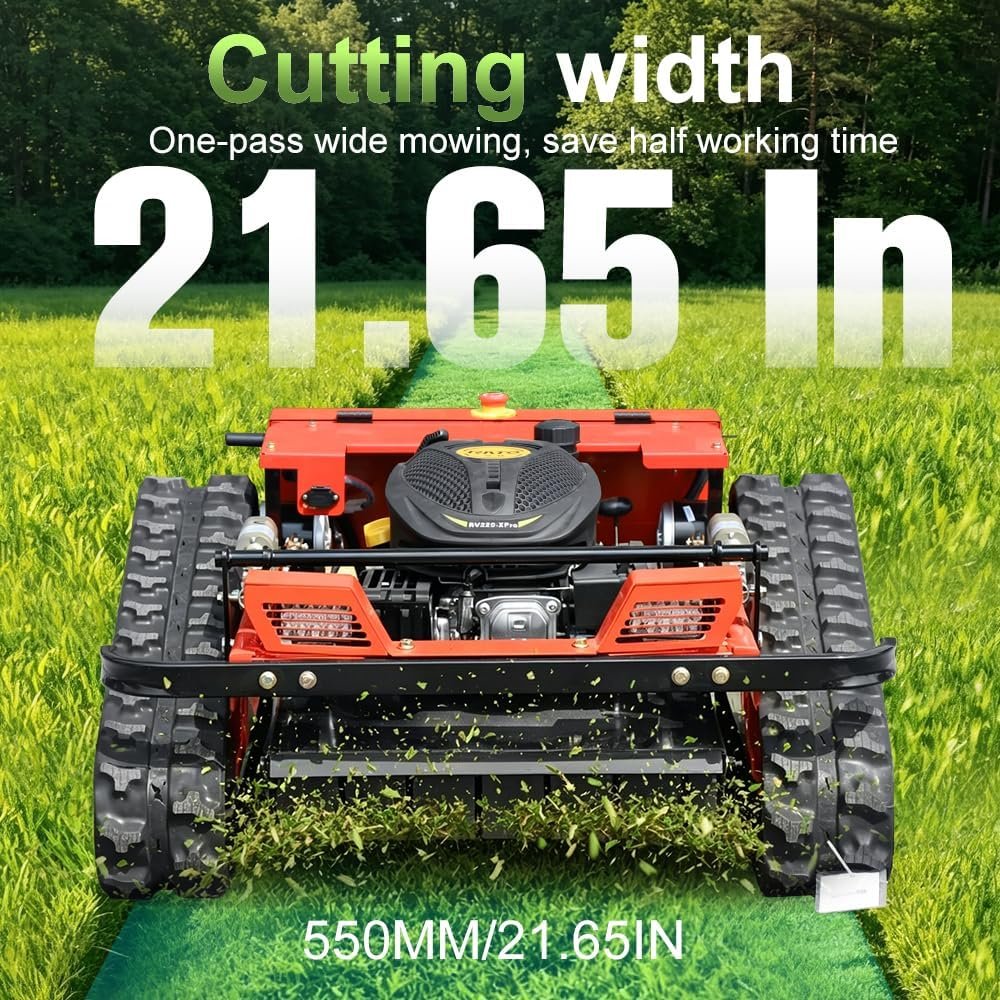
- Cutting width — Influences productivity and machine maneuverability.
- Machine dimensions — Particularly important for orchards, solar farms, gates, and narrow access areas.
- Machine weight — Affects transportation, traction, ground pressure, and slope behavior.
- Cutting height — Determines the range of vegetation heights the machine can maintain.
- Drive system — Electric, hydraulic, or mechanical drive systems have different characteristics.
- Track or tire design — Influences traction and terrain capability.
- Center of gravity — Particularly important for slope applications.
- Remote control range — Consider practical operating distance, not just the maximum advertised range.
- Engine or motor — Check manufacturer, rated power, serviceability, and spare-parts availability.
- Cutting system — Make sure the mower is designed for the vegetation you actually need to cut.
How to Choose a Remote Control Lawn Mower
Before comparing models, define the application.
Start with these questions:
- What type of vegetation needs to be cut?
- What is the normal working slope?
- What is the maximum slope?
- Is the ground firm, loose, muddy, rocky, or uneven?
- Are there width or height restrictions?
- How many hours per day will the machine operate?
- Is a rotary or flail cutting system more suitable?
- How will the mower be transported?
- Are replacement parts readily available?
- What technical and after-sales support is available?
Once these requirements are clear, specifications and prices become much easier to compare.
The lowest-priced machine is not necessarily the lowest-cost solution if it is poorly matched to the terrain or vegetation.
Remote Control Mower vs Robotic Lawn Mower
Remote control and robotic lawn mowers are often confused, but they solve different problems.
A robotic lawn mower is primarily designed for autonomous lawn maintenance. It operates automatically within a defined working area.
A remote control lawn mower is actively controlled by an operator from a distance.
In simple terms:
Robotic mower = automated lawn maintenance
Remote control mower = remote operation in challenging areas
Robotic mowers are typically associated with maintained residential or commercial lawns.
Remote control mowers are more commonly used on slopes, rough terrain, orchards, solar farms, roadside areas, and heavier vegetation.
Final Thoughts
A remote control lawn mower is more than a conventional mower equipped with a wireless controller.
Its performance depends on how the undercarriage, power system, cutting system, machine geometry, and remote control system work together.
For regular grass on relatively easy terrain, a compact rotary mower may be sufficient. For steep slopes, orchards, solar farms, roadside vegetation, and overgrown land, a tracked or flail mower may be more appropriate.
Instead of simply choosing the machine with the highest horsepower or lowest price, start with the application.
The right question is:
Which remote control mower best matches the terrain, vegetation, slope, and working conditions?
FAQs About Remote Control Lawn Mowers
Some models are specifically designed for slope mowing. Suitability depends on center of gravity, traction, braking, machine geometry, rated slope capability, and actual ground conditions.
Tracks generally provide a larger ground-contact area and can improve traction on loose or uneven terrain. Wheels may be more efficient on firm, relatively level surfaces. Neither is automatically better for every application.
Yes, but cutting capability depends on the machine. Rotary mowers can handle grass and moderate vegetation, while flail mowers are generally better suited to tall grass, dense weeds, and rough vegetation.
Yes. Compact tracked or wheeled remote control mowers can be useful between orchard rows, especially on uneven or sloped terrain. Machine width and maneuverability should be checked carefully.
Not necessarily. A standard remote control mower requires an operator to control the machine. Autonomous mowing is a separate feature and should only be assumed when specifically provided by the manufacturer.
There is no single specification that determines the best machine. The mower should be matched to the terrain, slope, vegetation, working area, required productivity, and operating conditions.