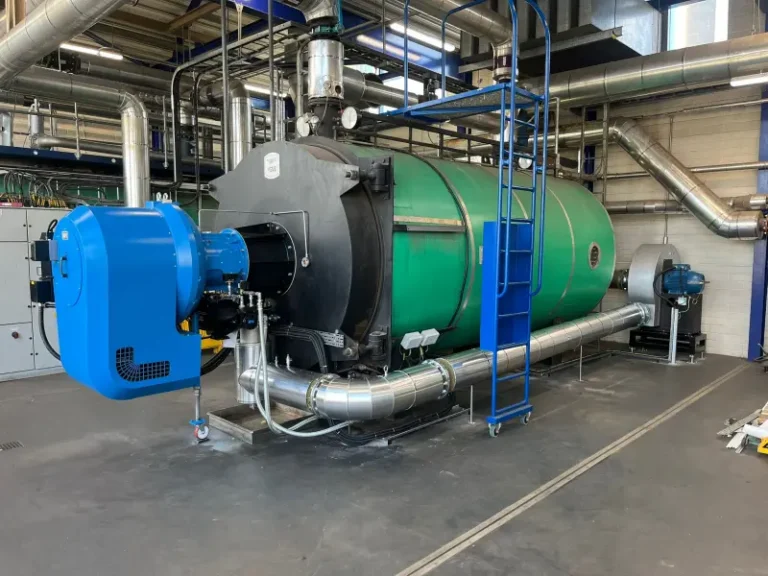
Industrial boilers are among the most important sources of thermal energy in modern industry. From food processing, textile production, pulp and paper, and chemical plants to sugar mills, biomass power plants, and industrial heating systems, boilers are widely used to produce steam, hot water, or high-temperature process heat.
However, an “industrial boiler” is not a single type of equipment. Boilers can be classified by the heating medium, construction, fuel, combustion technology, steam conditions, and application.
Understanding these basic classifications is the first step toward selecting the right boiler for an industrial project.
What Is an Industrial Boiler?
A boiler is essentially a piece of equipment that converts energy from fuel, electricity, or another heat source into usable thermal energy.
For a conventional steam boiler, the process can be simplified as:
Fuel → Combustion → Hot Flue Gas → Heat Transfer Surfaces → Water → Steam
If the steam is heated further after evaporation, it becomes superheated steam.
The steam produced by an industrial boiler may be used directly for process heating or supplied to a steam turbine for power generation.
A complete industrial boiler system may include much more than the boiler pressure parts themselves. Typical systems include:
- Fuel storage and feeding system
- Combustion system
- Boiler pressure parts
- Feedwater system
- Superheater
- Economizer
- Air preheater
- Forced-draft and induced-draft fans
- Flue gas cleaning equipment
- Ash handling system
- Automatic control system
- Stack or chimney
For biomass- and coal-fired boilers, fuel handling and ash removal can represent a significant part of the overall plant.
Main Types of Boilers by Heating Medium
One of the easiest ways to understand industrial boilers is to classify them according to what they produce.
Steam Boilers
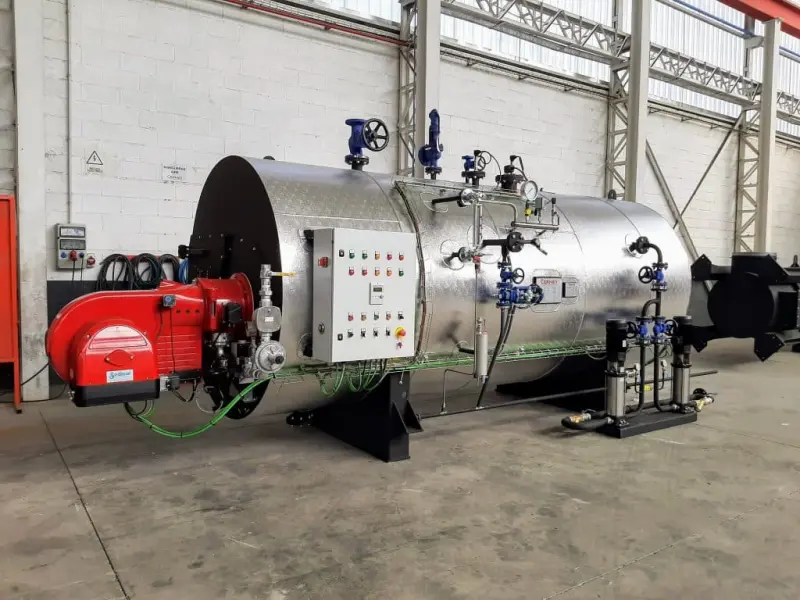
A steam boiler heats water to generate steam and is one of the most widely used types of industrial boilers.
Typical applications include:
- Food and beverage processing
- Textile and dyeing
- Pulp and paper
- Chemical production
- Pharmaceutical plants
- Rubber processing
- Wood processing
- Sugar mills
- Power generation
Industrial steam boiler capacity is commonly expressed in:
t/h or TPH — tonnes of steam per hour
For example: 10 TPH Steam Boiler
means that the boiler has a nominal steam generation capacity of approximately 10 tonnes per hour.
However, steam capacity alone is not enough to specify a boiler.
Steam pressure, temperature, and whether the steam is saturated or superheated are equally important.
Hot Water Boilers
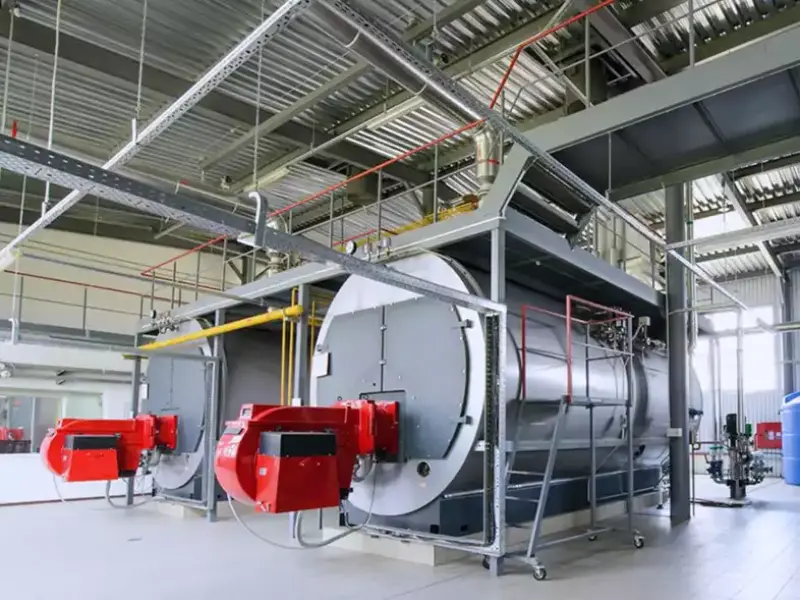
A hot water boiler is designed primarily to heat circulating water rather than generate steam.
Typical applications include:
- Hotels
- Hospitals
- Schools
- District heating
- Residential complexes
- Factory heating
- Industrial hot-water systems
Hot water boiler capacity is commonly expressed in:
kW, MW, kcal/h, or BTU/h
Therefore, when receiving a new boiler inquiry, one of the first questions should be: Does the customer require steam, hot water, or thermal oil?
Thermal Oil Heaters
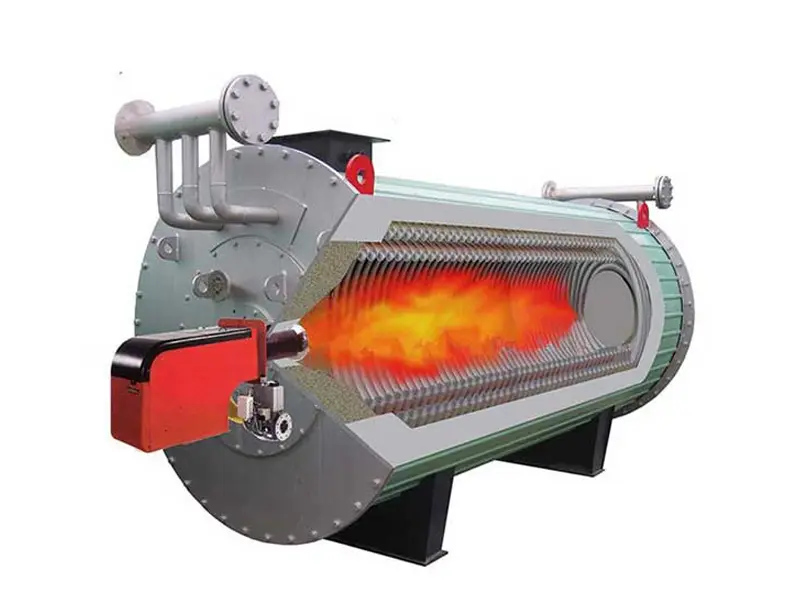
A thermal oil heater, also known as a thermal fluid heater, uses heat-transfer oil instead of water or steam as the heat-transfer medium.
One of its main advantages is the ability to achieve relatively high process temperatures without operating at the high pressures normally associated with steam systems at similar temperatures.
Thermal oil systems are therefore commonly considered for processes requiring temperatures of:
200°C, 250°C, 300°C, or higher.
Typical applications include:
- Chemical processing
- Petrochemical plants
- Asphalt production
- Edible oil processing
- Plywood manufacturing
- Textile finishing
- Plastics
- Composite materials
Fire-Tube vs. Water-Tube Boilers
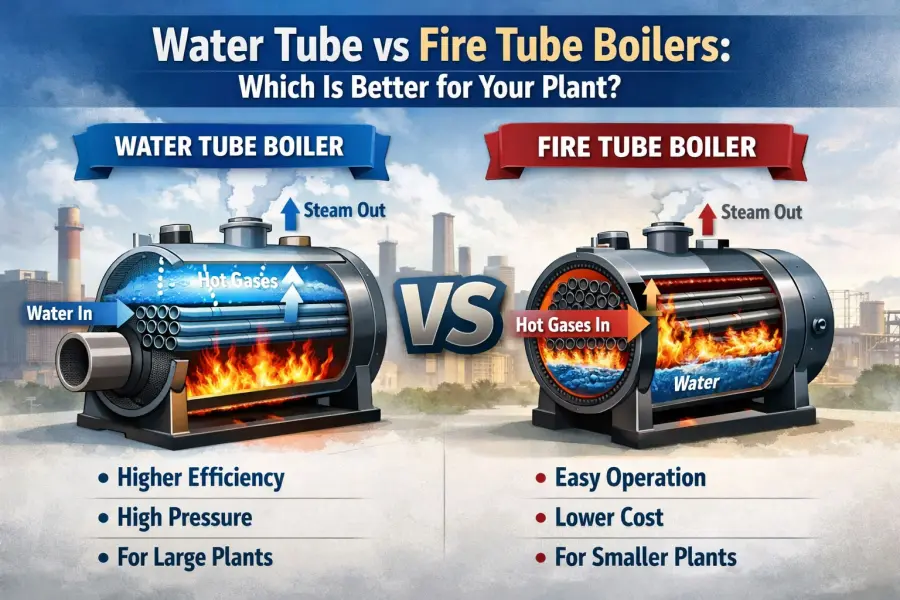
One of the most important structural classifications is the difference between fire-tube and water-tube boilers.
Fire-Tube Boilers
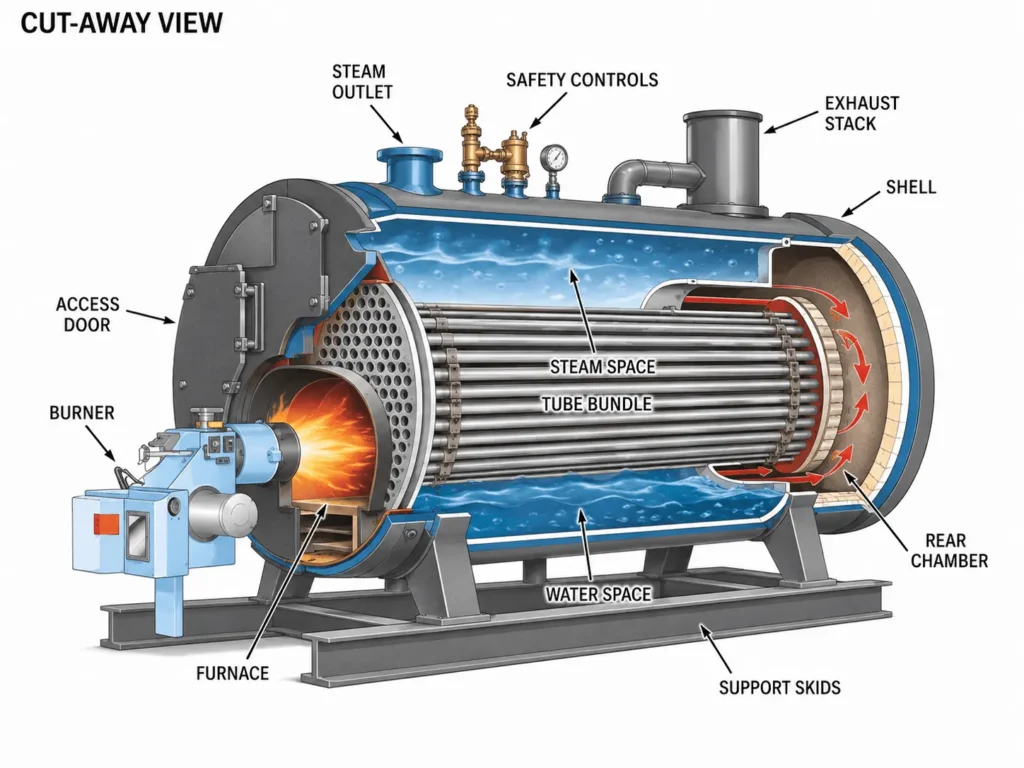
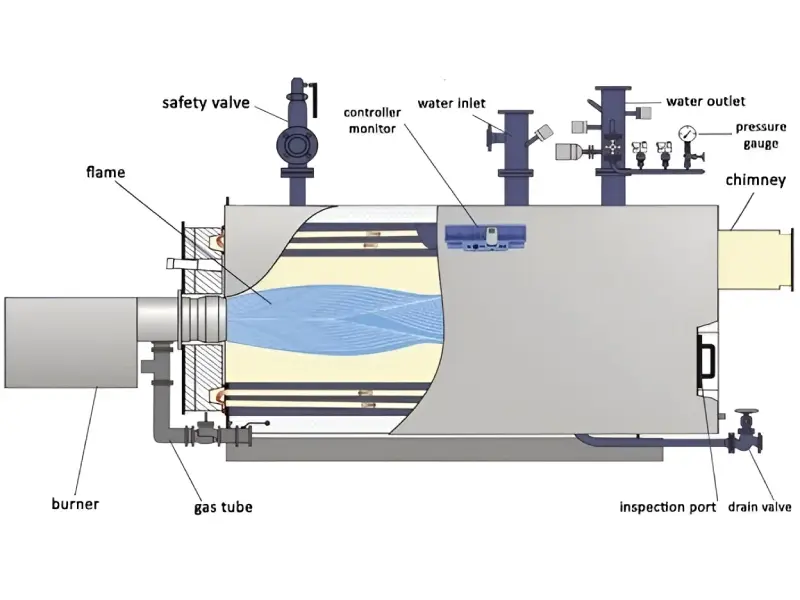
In a fire-tube boiler: Hot combustion gases flow inside the tubes, while water surrounds the tubes.
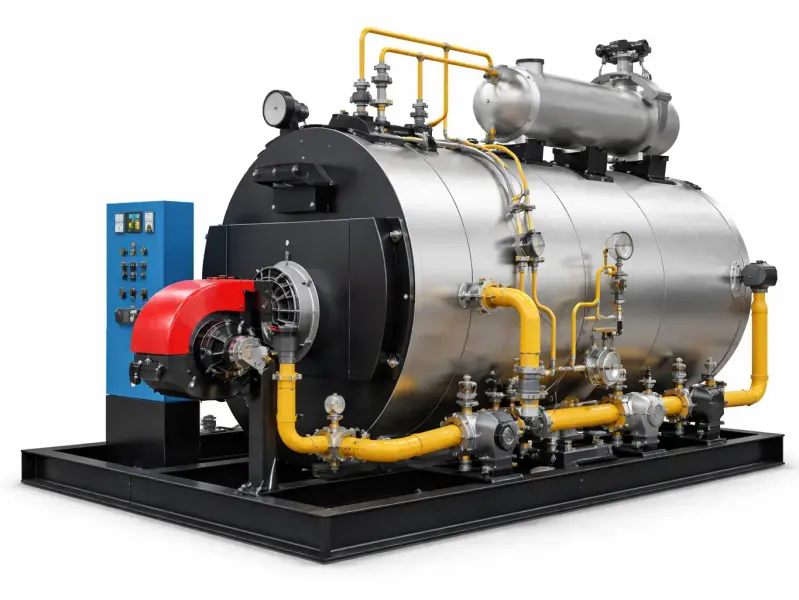
Many packaged oil- and gas-fired boilers use this construction.
Fire-tube boilers are commonly selected for small- and medium-capacity industrial applications because of their relatively compact construction, straightforward operation, and cost-effectiveness.
Water-Tube Boilers
In a water-tube boiler, the arrangement is essentially reversed: Water and steam flow inside the tubes, while hot combustion gases pass around the outside of the tubes.
Water-tube construction is particularly suitable for:
- Higher steam capacities
- Higher operating pressures
- Higher steam temperatures
- Large industrial plants
- Biomass-fired boilers
- Power-generation boilers
For this reason, water-tube designs are commonly found in larger and higher-pressure steam systems.
Industrial Boiler Types by Fuel
Industrial boilers can also be classified according to their energy source.
Gas-Fired Boilers
Gas-fired boilers commonly use fuels such as:
- Natural gas
- LPG
- Other suitable gaseous fuels
They offer relatively straightforward fuel handling, good combustion control, and a high degree of automation.
Oil-Fired Boilers
Oil-fired boilers may use diesel, light fuel oil, or other suitable liquid fuels.
They remain important in locations where natural gas infrastructure is limited or where liquid fuel is required as a backup energy source.
Biomass-Fired Boilers
Biomass boilers can use many different renewable or agricultural fuels, including:
- Wood chips
- Sawdust
- Wood pellets
- Rice husk
- Palm kernel shell
- Bagasse
- Other agricultural and forestry residues
However, “biomass” is not a single standardized fuel.
For example, dry wood pellets behave very differently from freshly produced sugarcane bagasse containing a high percentage of moisture.
Therefore, biomass boiler selection should always be based on an actual fuel analysis.
Coal-Fired Boilers
Depending on boiler capacity and coal characteristics, coal-fired boilers may use grate combustion, fluidized-bed combustion, or other combustion technologies.
Modern coal-fired projects must also consider emissions such as:
- Particulate matter
- SOx
- NOx
and the corresponding flue-gas treatment systems.
Electric Boilers
Electric boilers convert electrical energy directly into steam or hot water.
They have several advantages:
- No conventional burner
- No onsite combustion flue gas
- Compact system
- Simple control
- Fast response
Their economic feasibility, however, depends heavily on local electricity prices and the required operating hours.
What Is a Biomass Boiler?
A biomass boiler converts the chemical energy stored in biomass into useful thermal energy.
The basic process is:
Biomass → Combustion → Heat → Water → Steam
The principle sounds simple, but biomass boiler design can be significantly more complicated because biomass fuels vary widely in physical and chemical properties.
Important fuel parameters include:
Moisture Content
LHV/NCV — Lower Heating Value
Ash Content
Volatile Matter
Particle Size
Bulk Density
Fuel Composition
For example, sugarcane bagasse typically has relatively high moisture content, low bulk density, and a fibrous structure.
Consequently: “30 TPH biomass boiler” is not a complete technical specification.
The boiler designer also needs to know whether the fuel is: Wood chips, rice husk, palm kernel shell, bagasse, or another biomass fuel.
How Can Sugarcane Bagasse Be Used for Power Generation?
When sugarcane is crushed in a sugar mill, a large quantity of fibrous residue known as bagasse is produced.
Bagasse still contains useful chemical energy and can therefore be burned as boiler fuel.
A typical bagasse-to-power system looks like this:
Sugarcane → Crushing → Bagasse →Bagasse-Fired Boiler → High-Pressure Superheated Steam → Steam Turbine →Generator →Electricity
In a sugar mill, steam leaving or extracted from the turbine can also be used to meet process heating requirements.
The system then becomes a cogeneration, or combined heat and power (CHP), plant.
In other words, the same bagasse fuel can provide both: Electricity + Process Steam
This makes cogeneration particularly attractive for the sugar industry.
Industrial Steam Boilers vs. Power-Generation Boilers
This distinction is important when evaluating boiler specifications.
Consider two boilers that are both rated: 30 t/h
They may be completely different machines.
One could be specified as: 30 t/h 1.25 MPa Saturated Steam
and primarily supply process steam to a factory.
Another could be: 30 t/h 3.82 MPa 450°C Superheated Steam
and supply steam to a turbine-generator set.
Therefore, a power-generation boiler should never be evaluated by steam capacity alone.
Three parameters should always be considered together: Steam Capacity × Steam Pressure × Steam Temperature
As pressure and temperature increase, requirements for boiler pressure parts, superheaters, materials, feedwater quality, controls, and turbine systems also become more demanding.
Grate Boilers vs. Circulating Fluidized Bed Boilers
For solid-fuel boilers, the combustion technology is another major design consideration.
Grate-Fired Boilers
In a grate-fired boiler, solid fuel burns on or above a grate.
Depending on the design, the combustion system may use a:
- Travelling Grate
- Reciprocating Grate
- Vibrating Grate
For biomass fuels such as wood chips or bagasse, the grate and furnace must be designed according to the actual fuel characteristics, particularly moisture content, particle size, ash properties, and combustion behavior.
CFB Boilers
CFB stands for:
Circulating Fluidized Bed Boiler
In a CFB boiler, fuel burns in a fluidized environment, while solid particles are separated and recirculated through the combustion system.
CFB technology can provide good fuel flexibility and is widely considered for larger solid-fuel and multi-fuel boiler projects.
However, an important engineering principle is: A large biomass boiler does not automatically require CFB technology.
The appropriate combustion technology should be selected according to fuel properties, boiler capacity, steam conditions, emissions requirements, load profile, plant complexity, and project economics.
What Do WNS, SZS, SZL, DZL, and Other Boiler Model Codes Mean?
When researching Chinese industrial boiler manufacturers, buyers frequently encounter model designations such as:
WNS, SZS, SZL, DZL, DZH, DHL, CFB, YLW, and YQW.
These are not simply marketing names. They generally provide information about the boiler arrangement, combustion method, or heat-transfer medium.
A simplified overview is:
| Boiler Series | Typical Application |
| WNS | Oil/gas-fired fire-tube boiler |
| SZS | Oil/gas-fired water-tube boiler |
| DZL | Grate-fired solid-fuel boiler |
| SZL | Double-drum solid-fuel steam boiler |
| DHL | Corner-tube boiler |
| CFB | Circulating fluidized bed boiler |
| YLW | Solid-fuel thermal oil heater |
| YQW | Oil/gas-fired thermal oil heater |
Exact construction and operating parameters should always be confirmed against the manufacturer’s technical documentation rather than determined solely from the model designation.
What Information Is Required to Select an Industrial Boiler?
A boiler inquiry should ideally provide much more information than: “Please quote a 20-ton boiler.”
A useful industrial boiler RFQ should include at least the following:
| Parameter | Example |
| Boiler application | Process / Power Generation |
| Steam capacity | 30 t/h |
| Working pressure | 3.82 MPa |
| Steam temperature | 450°C |
| Steam condition | Superheated |
| Fuel | Bagasse |
| Fuel moisture | 50% |
| Fuel LHV/NCV | MJ/kg |
| Operating hours | 8,000 h/year |
| Feedwater temperature | °C |
| Emission requirements | mg/Nm³ |
| Installation location | Thailand |
| Applicable standard | GB / ASME / EN, etc. |
For biomass power-generation projects, additional information should include:
- Annual fuel availability
- Fuel analysis
- Steam turbine parameters
- Required electrical output
- Process steam demand
- Annual operating schedule
- Whether electricity will be exported to the grid
A Simple Industrial Boiler Selection Process
A preliminary boiler selection can follow this sequence:
What type of heat does the plant need?
↓
Steam / Hot Water / Thermal Oil
↓
Required Capacity
↓
Required Pressure & Temperature
↓
Fuel Type
↓
Gas / Oil / Coal / Biomass / Electricity
↓
Analyze the Fuel
↓
Select Combustion Technology
↓
Select Boiler Construction
↓
Fire Tube / Water Tube
↓
Select Auxiliary & Emission Systems
For a power-generation project, the process continues:
Boiler
↓
Superheated Steam
↓
Steam Turbine
↓
Generator
↓
Gross Power Output
↓
Plant Auxiliary Consumption
↓
Net Power Output
This system-level approach is particularly important for biomass and cogeneration projects.
Conclusion
Industrial boiler selection may initially appear complicated, but the process begins with a few fundamental questions:
- What heating medium is required?
- How much steam or thermal energy is needed?
- What pressure and temperature are required?
- What fuel will be used?
- What are the actual fuel properties?
- Will the steam be used for industrial processing or power generation?
Once these conditions are established, engineers can evaluate the appropriate boiler construction, combustion technology, pressure level, heat-recovery equipment, emissions-control system, and auxiliary equipment.
This is particularly important for biomass boilers.
A specification such as “30 TPH boiler” describes only the steam capacity — it does not define the complete boiler.
A properly selected industrial boiler must be engineered around the fuel, steam conditions, process requirements, environmental requirements, and overall energy system.
Frequently Asked Questions About Industrial Boilers
A properly designed and maintained industrial boiler can operate for 20 years or longer. Actual service life depends on water quality, operating conditions, maintenance, corrosion control, cycling frequency, and the condition of pressure parts
Fuel consumption depends on steam capacity, steam pressure and temperature, feedwater temperature, boiler efficiency, and the fuel's heating value. For biomass boilers, moisture content can significantly affect actual fuel consumption
The required space depends on much more than the boiler itself. Biomass and coal-fired plants generally require additional space for fuel storage, conveying equipment, ash handling, dust collection, fans, water treatment, and other auxiliary systems.
Manufacturing time varies considerably with boiler size and complexity. Standard packaged boilers can generally be produced faster, while large water-tube, biomass, high-pressure, or power-generation boilers usually require longer engineering and manufacturing schedules.
Boiler feedwater normally requires treatment to control hardness, dissolved solids, oxygen, pH, and other impurities. Higher-pressure boilers generally require stricter feedwater and boiler-water quality because deposits and corrosion can cause serious damage to pressure parts and superheaters.
In some cases, yes. Oil- and gas-fired boilers may allow relatively straightforward burner modifications, while conversion between substantially different fuels—such as coal, wood chips, or bagasse—can require major changes to the furnace, fuel-feeding system, heating surfaces, air system, ash handling, and emissions equipment. A technical assessment is required before conversion.
Depending on the project, a boiler plant may include feedwater pumps, deaerator, water-treatment equipment, economizer, air preheater, FD/ID fans, fuel handling equipment, dust collector, ash handling equipment, control system, and stack. Buyers should therefore clarify whether a quotation covers only the boiler or the complete boiler system.
Rated boiler capacity is the steam output under specified design conditions. Actual steam production can change with fuel quality, feedwater temperature, operating pressure, ambient conditions, fouling, equipment condition, and operating load. This is especially important for biomass boilers because fuel moisture and heating value can vary significantly.