Remote control lawn mowers are increasingly used for vegetation management on slopes, orchards, solar farms, embankments, large lawns and uneven terrain.
One of the first decisions when choosing a remote control mower is whether to use a tracked or wheeled drive system.
Both types allow the operator to control the mower from a distance, but they behave differently on slopes, soft ground, maintained lawns and rough terrain.
In general, tracked remote control mowers are well suited to slopes and uneven terrain, while wheeled remote control mowers can be lighter and more maneuverable on relatively flat, firm ground.
The better choice depends on your terrain, vegetation and working conditions.
Tracked vs Wheeled Remote Control Mowers: Quick Comparison
| Factor | Tracked Remote Control Mower | Wheeled Remote Control Mower |
| Ground Contact | Larger | Smaller |
| Uneven Terrain | Well suited | Better on smoother terrain |
| Slopes | Common application | Depends strongly on tire traction |
| Soft Ground | Better weight distribution | More concentrated ground loading |
| Maintained Lawns | Suitable, but may be unnecessary | Often a practical choice |
| Maneuverability | Stable tracked movement | Often agile on firm, flat surfaces |
| Machine Weight | Usually heavier | Usually lighter |
| Orchards | Good for uneven orchard terrain | Good for flatter orchard ground |
| Embankments | Common application | More terrain-dependent |
| Solar Farms | Well suited to uneven sites | Suitable for flatter sites |
| Mechanical Complexity | Generally higher | Generally simpler |
| Typical Use | Difficult terrain & professional vegetation management | Lawns, landscaping & lighter-duty applications |
What Is a Tracked Remote Control Mower?
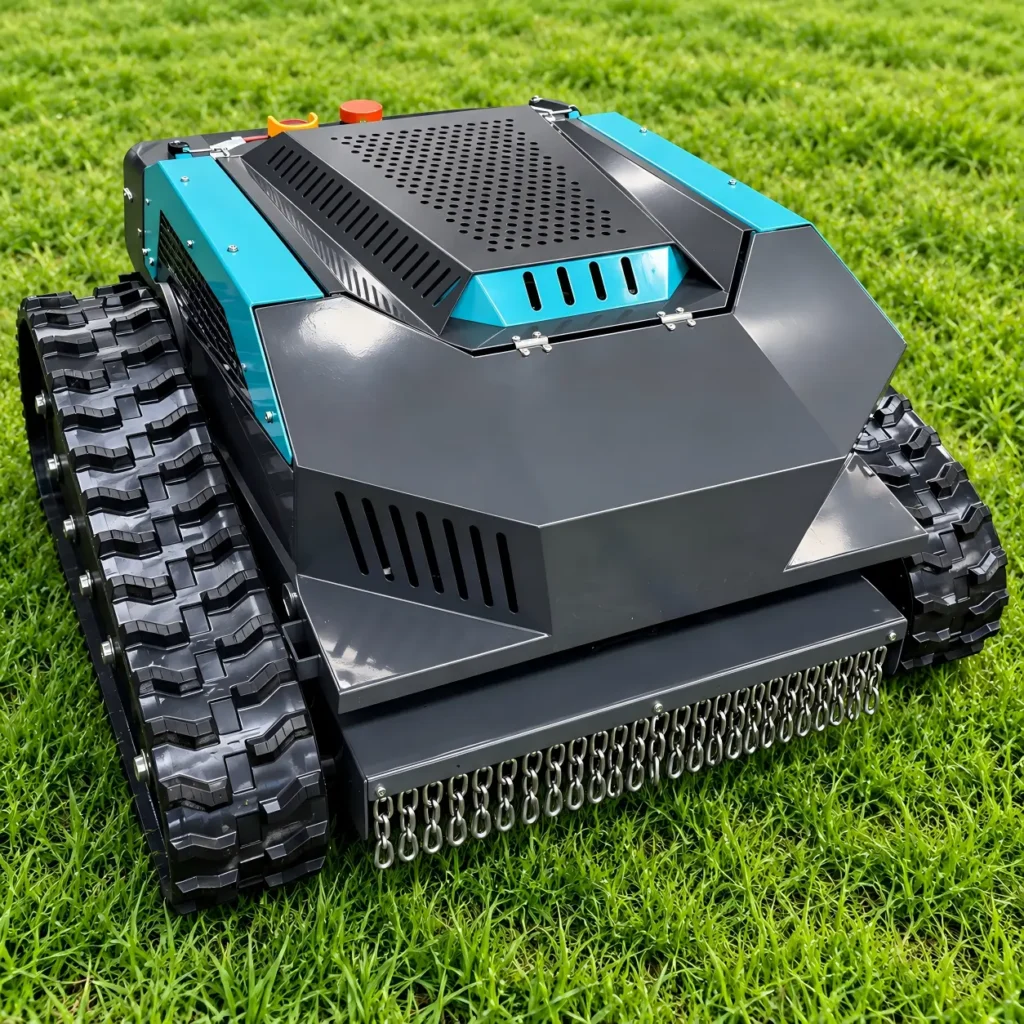
A tracked remote control mower uses rubber tracks instead of conventional wheels.
The tracks distribute the machine’s weight across a larger contact area. Left and right tracks are normally driven independently, allowing the machine to steer by changing the speed or direction of each side.
This configuration is commonly used for:
- Slopes and embankments
- Orchards and agricultural land
- Uneven or rough terrain
- Solar farms
- Tall grass and overgrown areas
- Hillsides and roadside vegetation management
The larger ground-contact area is one reason tracked machines are commonly selected when traction and terrain capability are more important than low machine weight.
What Is a Wheeled Remote Control Mower?
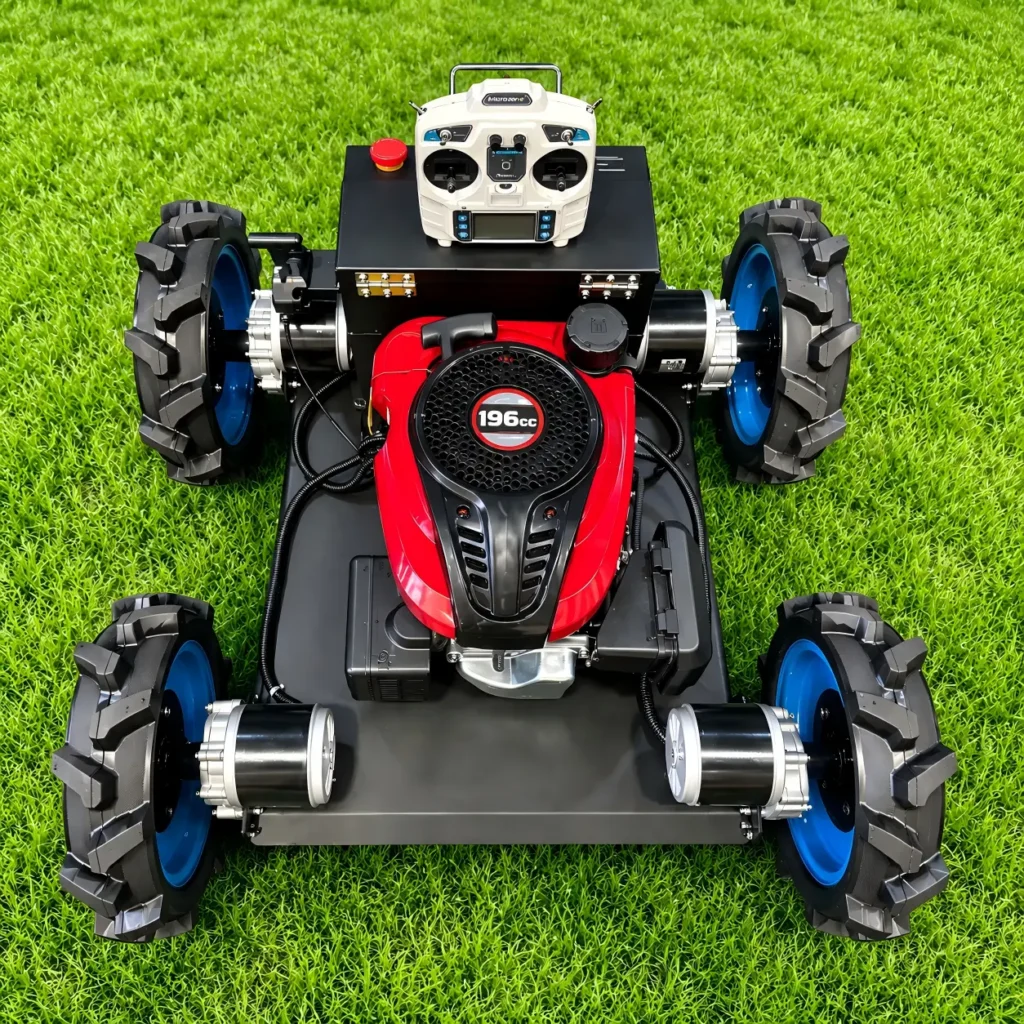
A wheeled remote control mower uses conventional tires instead of tracks.
Depending on the design, the machine may use two-wheel or four-wheel drive. Some compact remote mowers use an independent electric motor for each wheel.
Wheeled machines can be a practical option for:
- Lawns
- Gardens
- Parks
- Courtyards
- Landscaping
- Relatively flat orchards
- Firm and maintained ground
Because wheeled designs can be lighter and mechanically simpler, there is little reason to automatically choose tracks if the machine will spend most of its time mowing relatively flat lawns.
Tracked vs Wheeled Mowers on Slopes
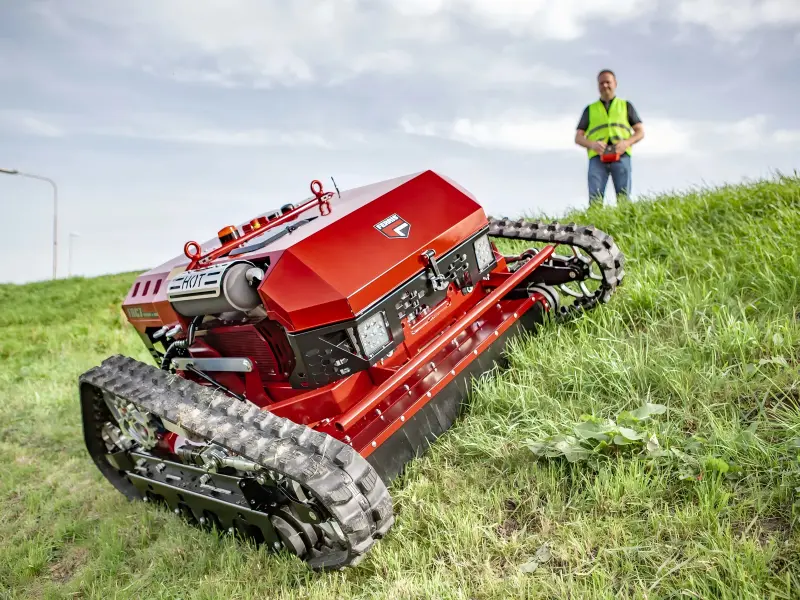
Slope mowing is one of the main reasons buyers consider a tracked remote control mower.
Tracks provide a relatively large contact area with the ground, which can help maintain traction across uneven surfaces.
However, the drive system alone does not determine whether a mower is suitable for a particular slope.
Slope performance can also be affected by:
- Center of gravity — A lower center of gravity can improve stability.
- Machine width — The relationship between track width, machine width and center of gravity affects stability.
- Surface conditions — Dry grass, wet grass, loose soil, mud and gravel provide very different levels of traction.
- Travel direction — Traveling directly uphill or downhill is different from traversing across a slope.
- Vegetation — Dense or wet vegetation can affect traction and cutting load.
- Machine speed — Operating behavior changes with travel speed.
- Attachment and deck position — Changes in machine configuration can affect weight distribution.
For this reason, buyers should not select a slope mower based only on a manufacturer’s maximum slope number.
Ask the supplier for both the manufacturer-rated maximum slope and practical working information, preferably supported by real operating videos under conditions similar to your application.
Why Tracks Can Help on Uneven and Soft Ground
Another difference between tracked and wheeled remote control mowers is how the machine’s weight is transferred to the ground.
A track contacts the ground over a relatively long area. A tire concentrates its load over a smaller contact patch.
This can make tracked machines useful on:
- Uneven agricultural land
- Rough grass
- Loose soil
- Irregular slopes
- Areas with small depressions and surface variations
But this does not mean tracks can never damage grass.
A heavy tracked mower making a tight pivot on a maintained lawn can disturb the turf. For decorative lawns and frequently maintained landscaping, a lighter wheeled machine may therefore be preferable.
Which Is Better for Orchards?
Both tracked and wheeled remote control mowers can work in orchards.
The choice depends primarily on terrain and row conditions.
Choose a tracked mower when:
The orchard is sloped, uneven or has loose ground; traction is an important consideration; or the mower must regularly cross rougher agricultural terrain.
Consider a wheeled mower when:
The orchard is relatively flat, the ground is firm and maintained, and a lighter, more maneuverable machine is preferred.
Machine width is also important.
Before selecting an orchard mower, compare the mower’s overall width with the actual spacing between trees, posts, irrigation systems and other obstacles—not just the cutting width.
Which Is Better for Lawns and Landscaping?
For maintained lawns, gardens and landscaping, a wheeled remote control mower can often be the more straightforward solution.
A compact wheeled mower can offer:
- Lower machine weight
- Good maneuverability
- Easier transportation
- Simple operation on firm ground
- Less need for a heavy tracked chassis
For example, a compact four-wheel-drive remote mower can be suitable for routine grass cutting where extreme terrain capability is unnecessary.
Tracked machines become more attractive as the ground becomes steeper, rougher or less predictable.
The important point is not to pay for terrain capability that your application does not require.
Tracked vs Wheeled Mowers for Solar Farms
Solar farms present a different mowing challenge.
Vegetation must often be managed:
- Between panel rows
- Around mounting structures
- On uneven ground
- Around cables and site infrastructure
- Under or near solar panels
For relatively flat solar installations with firm ground, either drive system may be suitable.
For sites with uneven terrain or slopes, a tracked remote control mower may offer practical advantages in traction and ground contact.
However, machine dimensions are especially important for solar farms.
Buyers should check overall mower width, mower height, turning space and panel clearance before selecting a machine.
Tracked Mowers for Embankments and Hillsides
Embankments, levees and hillsides are among the most demanding mowing environments.
These areas may combine:
- Steep gradients
- Uneven surfaces
- Tall vegetation
- Limited operator access
- Changes in soil conditions
- Ditches or obstacles
Remote operation allows the operator to control the machine from a distance rather than riding directly on the mower.
Tracked drive is commonly used for these applications because of its ground contact and terrain capability.
Still, a machine’s actual suitability must be evaluated against the specific slope, vegetation and ground conditions of the project.
What About Tall Grass and Overgrown Areas?
Drive system is only one part of the equation.
For tall grass, weeds and dense vegetation, the cutting system and engine power may be just as important as whether the mower uses tracks or wheels.
When comparing machines for overgrown areas, check:
- Cutting width A wider deck can cover more ground per pass.
- Cutting system Rotary, swinging-blade and true flail systems behave differently in different vegetation.
- Engine power Denser vegetation can place greater load on the cutting system.
- Deck adjustment Greater adjustment can help accommodate different vegetation conditions.
- Travel speed Higher maximum speed does not necessarily mean faster mowing in dense vegetation.
A mower designed for maintained lawn grass may not be the best machine for heavy weeds simply because it uses tracks.
Tracked vs Wheeled: Maintenance Considerations
Tracked and wheeled machines also have different maintenance requirements.
A tracked system typically includes tracks, drive wheels, rollers or supporting components and track-tensioning mechanisms. Tracks should be inspected regularly for wear, damage and correct tension.
Wheeled machines generally have a simpler running system, although tires still require inspection for wear, damage and appropriate pressure where pneumatic tires are used.
When buying either type, ask about:
- Replacement tracks or tires
- Drive motors
- Blades
- Belts
- Filters
- Bearings
- Remote-control components
- Engine service parts
For professional users, spare-parts availability can be as important as the initial machine specification.
Other Specifications You Should Compare
Do not choose a remote control mower based only on tracks vs wheels.
A useful comparison should include:
| Specification | Why It Matters |
| Cutting Width | Determines mowing coverage per pass |
| Overall Dimensions | Affects access and transportation |
| Machine Weight | Affects transport and ground pressure |
| Engine | Important for cutting-system performance |
| Drive Motors | Power the machine’s movement |
| Cutting System | Determines suitability for different vegetation |
| Deck Adjustment | Helps adapt to vegetation and terrain |
| Travel Speed | Affects movement and productivity |
| Remote Range | Determines potential operating distance |
| Track/Tire Design | Affects terrain interaction |
| Parts Availability | Important for long-term operation |
| Service Support | Important for commercial equipment |
Example: SDL452-70B Tracked Remote Control Mower
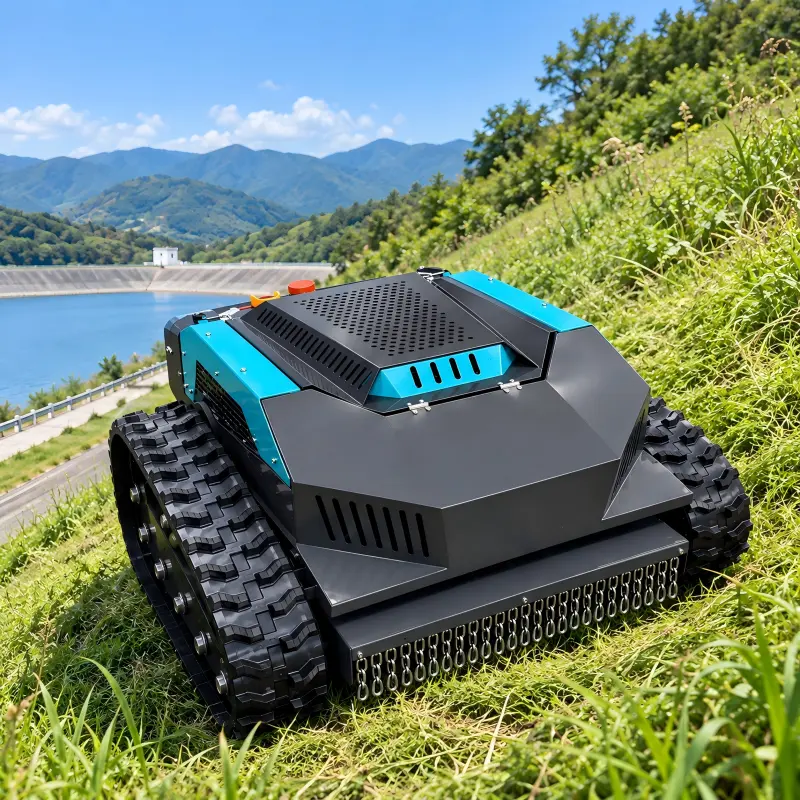
For buyers considering a tracked remote control mower for slopes, orchards, solar farms and uneven terrain, the SDL452-70B is an example of a mid-range tracked configuration.
Its main specifications include:
- 700 mm cutting width
Provides more coverage than compact 500–550 mm machines while maintaining a relatively compact footprint. - 452 cc / 16 HP Loncin gasoline engine
Provides power for the cutting system. - 800 W × 2 electric track motors
Independent electric tracked drive for machine movement. - Remote-controlled deck adjustment
Allows the operator to adjust the deck remotely. - 220 kg machine weight
Positions the SDL452-70B between lighter compact tracked mowers and larger heavy-duty models. - The SDL452-70B is therefore positioned as a versatile multi-terrain remote control mower, rather than the largest or heaviest machine in the MecBase range.
So, Should You Choose Tracks or Wheels?
A simple way to narrow down the choice is to start with your terrain.
Consider a wheeled remote control mower if most of your work involves relatively flat, firm and maintained ground such as lawns, gardens and landscaping.
Consider a tracked remote control mower if your work regularly involves slopes, embankments, rough agricultural ground, uneven orchards or other challenging terrain.
But terrain is only the starting point.
The final selection should also consider vegetation type, cutting width, machine dimensions, slope conditions, cutting system, engine, operating hours, transportation and spare-parts support.
Need Help Choosing a Remote Control Mower?
Choosing between a tracked and wheeled remote control lawn mower starts with understanding the terrain.
Tell MecBase:
Where will the mower work?
What vegetation will it cut?
What are the normal and maximum slopes?
Is the ground firm, soft or uneven?
How large is the working area?
We can help compare available mower configurations based on your application.
FAQs About Remote Control Lawn Mowers
Tracked mowers are commonly used on slopes because their tracks provide a larger ground-contact area. However, actual slope capability also depends on center of gravity, machine design, surface conditions, vegetation, travel direction and operating speed.
They can. Heavy tracked machines, particularly when making tight turns, may disturb maintained turf. For flat decorative lawns, a lighter wheeled mower may be more appropriate.
Yes. Wheeled models can work well in relatively flat orchards with firm ground. Tracked models may be more suitable where the orchard is sloped, soft or uneven.
They can be particularly useful on uneven or sloped solar farm sites. Overall width, height, turning radius and clearance around solar structures should also be checked.
There is no single mower that is best for every slope. Compare the machine's tracked or wheeled design, center of gravity, dimensions, weight, traction, manufacturer-rated slope capability and evidence from real operating conditions similar to your site.
Provide your vegetation type, working area, normal slope, maximum slope, ground conditions, required cutting width, access limitations and expected working hours per day.