Spreader Bars vs. Lifting Beams: Definitions, Differences, and Design

Lifting Beams and Spreader Bars are two different below-the-hook devices in common use to transfer loads. Both devices have a similar function: to transfer the loads from multiple locations to the (single) crane hook, to spread out the load and provide balance to the lift.

And yet each of these tools has different properties and applications. The main difference between the two types of lifting devices is the type of forces that are applied to the beam.

A lifting operation with a crane will usually need lifting equipment to attach the crane to the load. The type of lifting gear required when moving something heavy from ‘A to B’ will depend on what’s being lifted and the details of the load: the size and weight, any lifting points to connect to, as well as the available headroom between the hook and the load.

Both types of devices are used to keep the lifting slings below the device at or near a 90° angle (perpendicular to the horizon). This helps to avoid damage to the load, damage to rigging hardware and lifting slings, and helps keep the slings from sliding off the load during the lift.

At Mecbase, we offer a wide selection of below-the-hook lifting devices in common sizes and configurations, and we also have a program completely dedicated to custom-engineered lifting products.

Our goal for this article is to provide a simple and easy-to-understand breakdown of spreader bars and lifting beams based on their design and the advantages and disadvantages of using each device.

Spreader Bars (Spreader Beams)

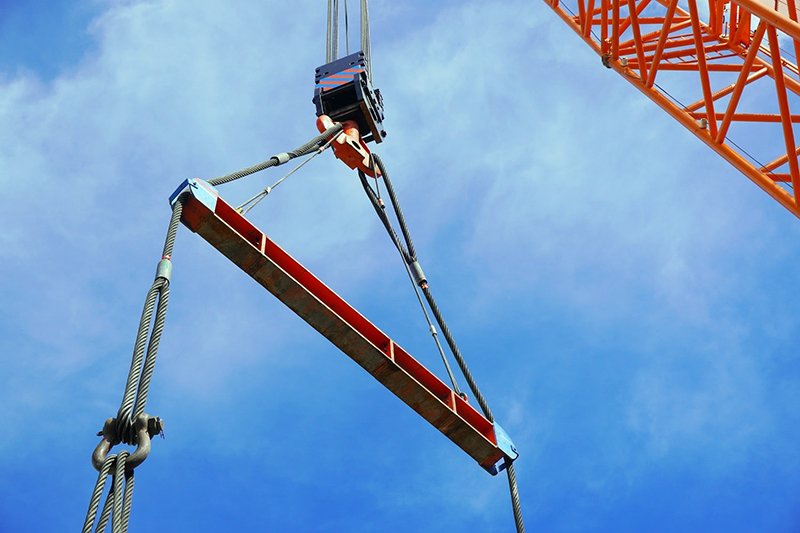
Spreader beams (spreader bars or lifting spreaders) consist of a long bar that serves to keep two slings apart from the lifting distance. It is designed with two lifting eyes at the top of the beam. The legs of a chain or sling convert the lifting loads into compressive forces in the bar, and tensile forces in the slings.

Spreader bars convert lifting loads into compressive forces in the beam and tensile forces in the slings.
Spreader Beams
Spreader Beams

Spreader bars are a popular choice, ideal when slings need to clear obstacles and headroom is not an issue. A spreader bar withstands crushing forces by putting a compressive stress on the beam. It keeps the slings below the beam at a 90° angle to avoid damaging the load. When the center of gravity of the load is central, the weight is equally distributed between the two slings.

Two lifting lugs on the top of the beam attach to the legs of a chain sling or synthetic sling at a particular angle designed to ensure pure compression. Two lugs on the bottom (one at each end) connect to a sling or hook which are then connected to the load.

Advantages of Using a Spreader Bar

  •  Lightweight and cost-effective – Because material is used efficiently, spreader bars are often lighter in weight, easier to design, and cheaper than lifting beams.
  • Adjustable length – The spreader bar can be easily adjusted in length to accommodate a range of lift spreads. Many spreader bars are designed with interchangeable parts, allowing the beam to be taken apart and made shorter or longer depending on the load.
  • Even load distribution – When the weight of the load is evenly distributed along the beam, there is no stress on a single lifting point, which reduces the chance of tipping or bending.
  • Ideal for wide or heavy loads – Due to their versatility and modularity, spreader bars provide excellent control over slings and the load, making them ideal for lifting very wide or heavy-duty loads.
  • Handles off-center loads – They can be engineered to allow incremental adjustment of sling angle and beam length for off-center load adjustments. Where the center of gravity is not central, safe rigging arrangements can be made.

Disadvantages of Using a Spreader Bar

  • Requires more headroom – A disadvantage is the required space above the bar, which sometimes results in a loss of lifting height. Spreader bars have top rigging consisting of wire rope, chain slings, or synthetic slings, so they are not ideal in situations where overhead room may be limited.
  • Risk of spinning – Long beams or uneven loads may require a tag line to keep the load under control and reduce the possibility of spinning, especially with particularly long spreader bars.
  • Limited support points – Loads being lifted using a spreader bar can typically only be supported on the two ends of the beam. If the load needs to be supported all the way throughout its length, a lifting beam may be more beneficial.
  • Cascading rig requires extra height – Loads with multiple lifting points can be lifted using a spreader bar by cascading rigging, but this requires a large amount of headroom.

Lifting Beams

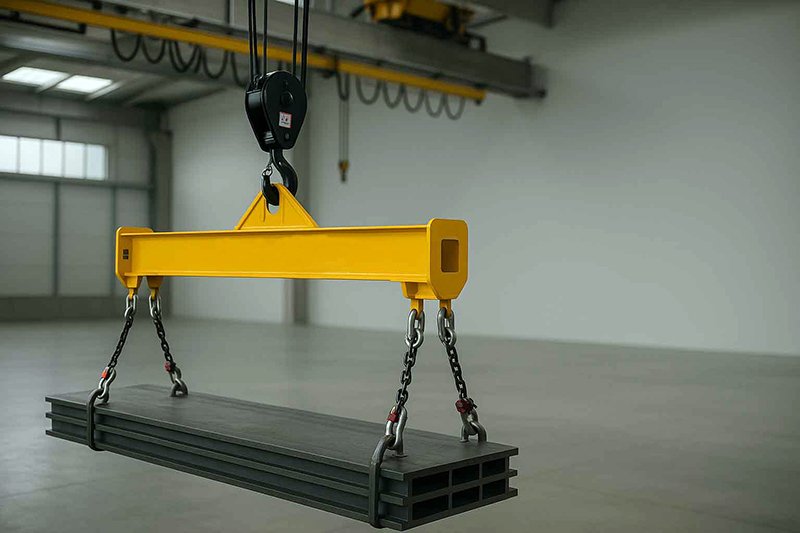
On the other hand, lifting beams consist of a long beam that serves the lifting load into a bending moment through the beam. It is a simple design with one lifting eye on the beam’s topside (or sometimes two bails for two crane hooks) for connecting the crane. Under the beam are two (or more) lugs attached that support the load via hook or sling.

Lifting beams convert lifting loads into bending forces on the beam.
Lifting Beams
Lifting Beams

Lifting beams are a good choice when headroom is restricted. Lifting beams can have a single or multiple attachment points on top of the beam to connect to the crane. Typically, there are two or more evenly spaced lifting lugs on the underside of the beam that attach to and support the load via hook or sling.
Advantages of Using a Lifting Beam

  • Low headroom requirement – The main advantage of lifting beams is the less required space above the beam to implement the lift. Because there is a single bail attachment on the top for the crane to attach to, it does not require the same amount of headroom that a spreader bar does.
  • Suitable for narrow environments – That is why lifting beams are suitable for a shorter span and lighter lifts in a more narrow environment.
  • Multiple lifting points – Lifting beams provide multiple lifting points underneath and can be designed with variable or fixed lifting lugs. This allows them to be used in many different applications and for many different types of loads.
  • Handles unbalanced and special loads – Adjustable design allows lifting beams to handle out-of-balance loads, control inward crushing forces, and utilize special load securement attachments.
  • Rigid and heavy-duty – The rigid and heavy-duty design of a lifting beam is ideal for loads that are too weak or flexible to be lifted without support—such as long or thin sheets of metal or steel plates.
  • Ideal for indoor or low-headroom lifts – A lifting beam is typically a low-height lifting solution, making it the ideal solution for indoor lifts or where lifts have restricted headroom.

Disadvantages of Using a Lifting Beam

  • Heavier and more expensive – Lifting beams are more rigid, use more material, and are heavier than an equivalent spreader bar to counteract the bending forces. Therefore, they don’t use material as efficiently and tend to be more expensive.
  • Less versatile for wide spans – Even a lightweight load that has a wide span will require a significant and rigid lifting beam, so a spreader bar may be more beneficial and cost-effective in such cases.
  • Potential need for tag line – When using a lifting beam, a tag line may be required to keep loads level and prevent tipping or spinning during the lift.
  • Transportation difficulty – The size and weight of a lifting beam can make it less versatile and more difficult to transport compared to a modular spreader bar.

Quick Comparison Table

FactorSpreader BarLifting Beam
Primary forceCompressionBending
Headroom neededHighLow
Best forWide, heavy loadsShort span, light loads, narrow environment
WeightLighterHeavier
CostLowerHigher
AdjustabilityLength adjustableLifting points adjustable
Support pointsOnly at endsEnds and intermediate points
ModularityHigh (interchangeable parts)Lower

How to Choose Between Lifting Beams and Spreader Bars

Ask yourself the following questions:

What are you lifting and how?

   The object’s weight as well as the point where the lifting points are located determine in part which tool you need.

  •    – Two-end support with centered CG → Spreader bar
  •    – Multi-point or flexible load → Lifting beam

Where are you lifting it?

  •    – Indoor / low headroom / narrow environment → Lifting beam
  •    – Open area with ample headroom → Spreader bar

Do you have enough height or a height restriction?

  •    – Low headroom → Lifting beam
  •    – Sufficient headroom → Spreader bar (but account for height loss from top slings)

Additional considerations:

  • – Load weight and span: Heavy-duty or wide-span loads → Spreader bar is often better.
  • – Full-span support needed: Load that needs support across its entire length, including the center → Lifting beam is better.
  • – Crane type: Special consideration should be given if used with a top-running or under-running overhead crane. A spreader bar requires more overhead room than a lifting beam.

Mecbase – Your Partner in Lifting Solutions

At Mecbase, we treat each lifting challenge the same—whether we’re making a common lift beam for a 150 lbs. load, or a specially-engineered 330-ton electric furnace lifter. We have a fully-staffed Engineering department, project managers, and estimators to help solve your lifting challenges and design the perfect solution for your unique lifting application.

We welcome the opportunity to address your overhead material handling needs. If you’re interested in learning more about how a below-the-hook lifting device can improve the efficiency and safety of your overhead lifts, or want to schedule a consultation, contact us to speak with a Specialist.

We are more than happy to advise you how to choose the right tool for your job. Please don’t hesitate to contact us!

Summary

Spreader Bar (Spreader Beam): Best when headroom is ample, loads are wide or heavy, and cost and weight are concerns. Supports loads only at two ends. Modular designs allow length adjustment.

Lifting Beam: Best when headroom is limited, environment is narrow, or loads need multi-point or full-span support. Heavier and more expensive but provides greater rigidity and multiple lifting points.

Both devices serve to stabilize and support loads during overhead lifts. Understanding their force characteristics, headroom requirements, and support capabilities is key to selecting the right tool for a safe and efficient lifting operation.

FAQs About Spreader Bars vs. Lifting Beams

The main difference is the type of force applied to the beam.

A spreader bar converts lifting loads into compressive forces in the beam and tensile forces in the slings.

A lifting beam converts lifting loads into bending forces (bending stress) in the beam.

A spreader bar requires more headroom because it uses two overhead slings attached to the top lifting lugs. This can result in a loss of lifting height. A lifting beam typically needs less headroom since it connects to the crane with a single bail on top.

Choose a spreader bar when:

You have ample headroom.

The load is wide or heavy.

You need adjustable length for different spans.

You want a lighter and more cost-effective solution.

The load can be supported only at its two ends.

Choose a lifting beam when:

Headroom is limited (indoor or low-clearance environments).

The load is long, flexible, or requires support along its entire length (e.g., thin metal sheets).


You need multiple lifting points along the bottom to support the load.

The environment is narrow and requires a compact lifting solution.

A lifting beam is generally more expensive than a spreader bar of equivalent capacity. Lifting beams use more material to resist bending stresses, making them heavier and more costly. Spreader bars are more material-efficient because they primarily handle compression, so they tend to be lighter and less expensive.

Typically no. A standard spreader bar supports the load only at its two ends. If a load requires intermediate support, a lifting beam with multiple bottom lugs is a better choice. Alternatively, you can use cascading rigging with a spreader bar, but this requires significant additional headroom.

Yes, many spreader bars are designed with adjustable or interchangeable parts. You can take them apart and change the length to suit different load spans. Lifting beams, on the other hand, are typically fixed in length but may offer adjustable lifting lug positions.

Both can be adapted. Spreader bars can be engineered to allow incremental adjustment of sling angles and beam length to handle off-center loads. Lifting beams with variable lifting lugs can also accommodate unbalanced loads by shifting the attachment points. However, for significantly off-center loads, custom engineering is required for either device.

It depends. Long spreader bars or uneven loads may require a tag line to prevent spinning and maintain control. Lifting beams may also benefit from a tag line to keep the load level and prevent tipping. A tag line is always a good safety practice when lifting long or unbalanced loads.

Table of Contents

Related Resources

Types of Lifting Hooks and Sling Hooks
Types of Lifting Hooks and Sling Hooks Explained

Learn about the different types of lifting hooks and sling hooks, including eye hooks, clevis hooks, grab hooks, swivel hooks, self-locking hooks, and foundry hooks. Discover their applications, safety features, lifting standards, and how to choose the right hook for industrial lifting operations.

Read More »
Scroll to Top

Contact Us Now