What is DIN 536 Crane Rail? A-Series Crane Rail Sizes and Specifications

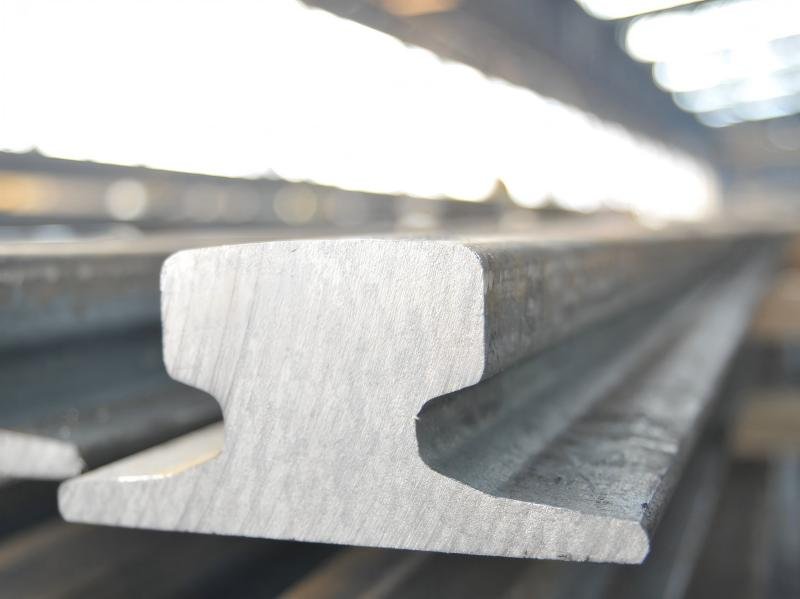
DIN 536 Part 1 is one of the most important European standards for crane rails used in industrial lifting systems. The standard specifies the dimensions, section parameters and steel grades of hot rolled flat bottom crane rails known as the A-Series crane rails.

These rails are widely used in overhead crane runways, gantry crane systems, ports, steel mills and heavy manufacturing facilities. By standardizing the geometry and mechanical properties of crane rails, DIN 536 ensures safe crane operation and compatibility between crane wheels and runway rails.

In this guide, we will explain what DIN 536 Part 1 is, the common A-series crane rail sizes, and how these rails are used in industrial crane systems worldwide.

Scope and Field of Application

This standard specifies requirements for hot rolled crane rails with a flat bottom (type A), with the dimensions specified in table 1 and made from steel with the properties specified in clause 4.

European Standards (DIN EN Crane Rail)

Dimensions and Designation

This standard specifies requirements for hot rolled crane rails with a flat bottom (type A), with the dimensions specified in table 1 and made from steel with the properties specified in clause 4.

Designation of a flat bottom crane rail (type A) complying with this standard, with a head width, k, of 100 mm (A 100) and made from steel with a minimum tensile strength of 690 N/mm²:

Crane rail DIN 536 – A 100 – 690

Explanation

  • A 100 identifies the rail profile defined in DIN 536 Part 1.
  • The number 100 corresponds to the rail head width (k) measured in millimeters.
  • The number 690 specifies the minimum tensile strength of the rail steel, indicating the mechanical strength of the material.

This designation ensures that the crane rail complies with the dimensional and mechanical requirements defined in the DIN 536 standard.
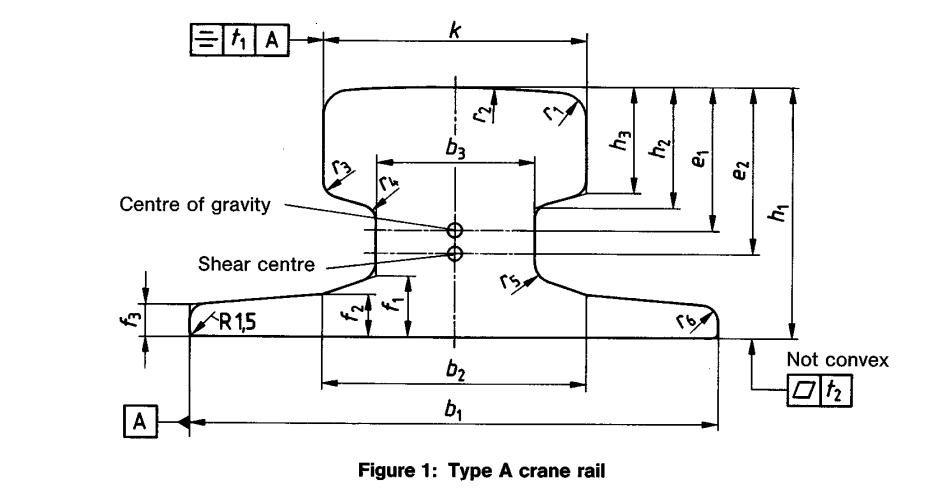
DIN 536 Rail Designation Figure 1 Type A Crane Rail
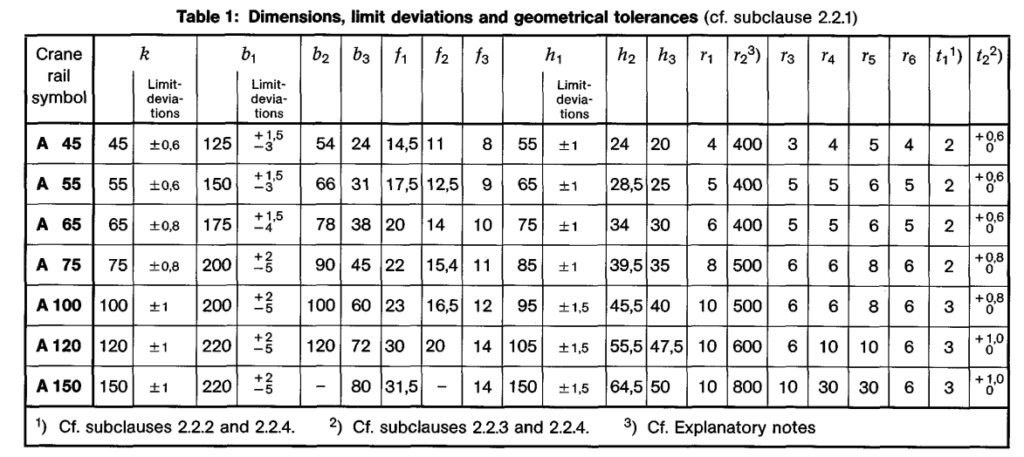
Table 1 Dimensions, limit deviations and geometrical tolerances (cf. subclause 2.2.1)
Figure 2 Tolerante on flatness of baseplate
  • Crane rails shall be of the sizes and be subject to the limit deviations and geometrical tolerances specified in table 1. Any values for which no tolerance is specified shall be regarded as approximate values.
  • The tolerance on the symmetry of the head, t₁, shall be established for two parallel surfaces at a distance of t₁ from each other, the reference plane being that at the centre of the head, which is equal to b₁/2.
  • The rail seat shall not be convex, the baseplate being subject to the tolerance on flatness, t₂, specified in table 1 (cf. figure 2).
  • The specifications given in ISO 1101 shall apply for tolerances t₁ and t₂

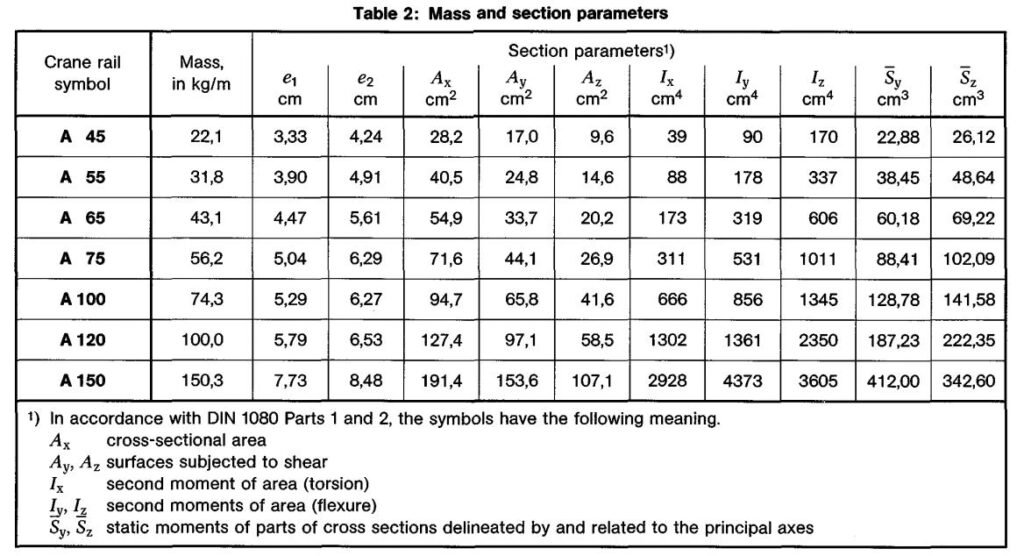
Mass and Section Parameters

  • Figure 3 illustrates the relevant stress components of crane rails, in accordance with DIN 1080 Parts 1 and 2.
  • The mass of crane rails, as a function of the section parameters, shall be as specified in table 2.
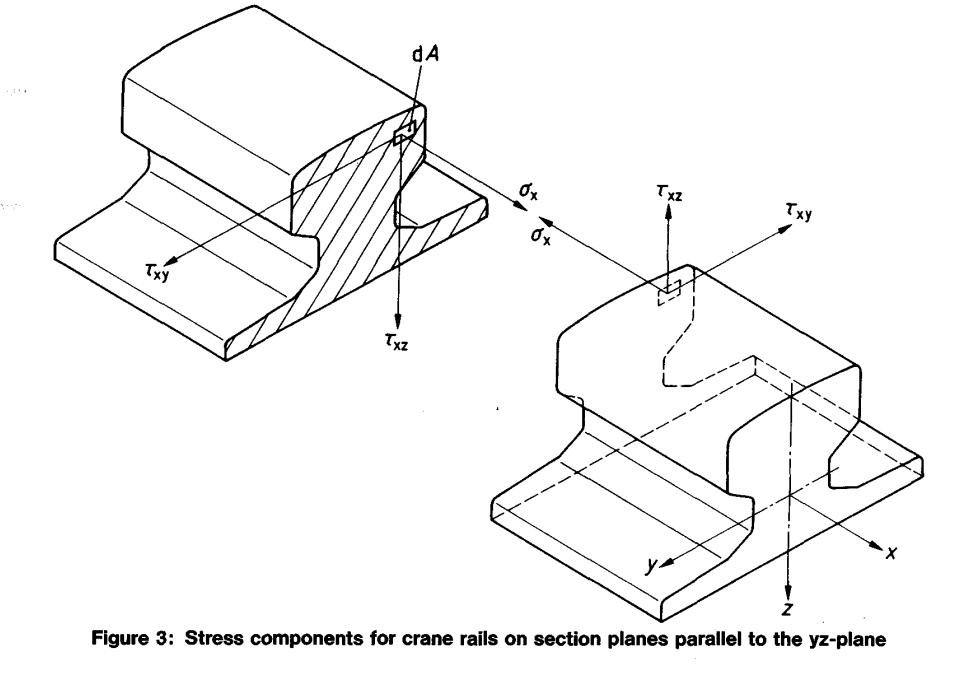
Figure 3 Stress components for crane rails on section planes parallel to the yz-plane
Table 2 Mass and section parameters

Materials

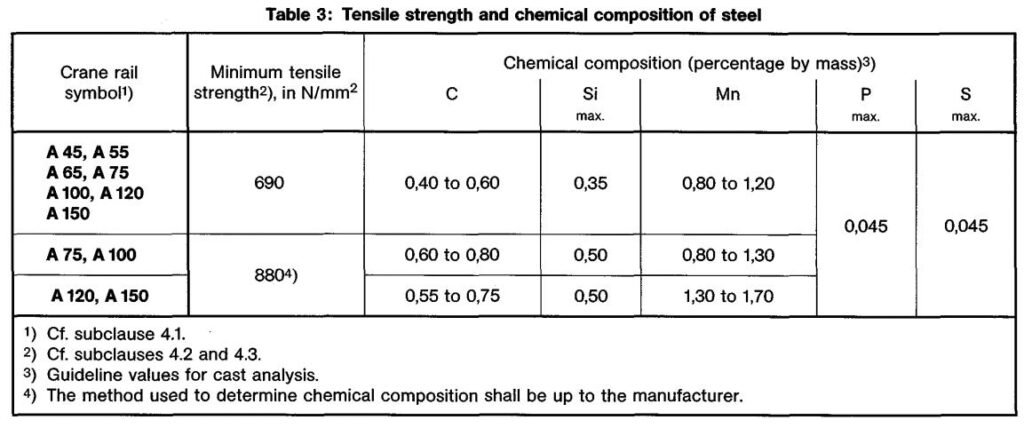
  • Hot rolled crane rails shall be made from steel complying with the specifications given in table 3. In the case of rail types A 75, A 100, A 120 and A 150, the required minimum tensile strength (690 or 880 N/mm²) shall be specified at the time of ordering.
  • The actual tensile strength of the material may be 20 N/mm² less than the minimum values specified, unless otherwise agreed at the time of ordering.
  • Tensile strength shall be determined on longitudinal test pieces which have been taken from the zone of the crane rail illustrated in figure 4.
  • Crane rails may be supplied with a DIN 50 049 inspection document, the type of document being the subject of agreement at the time of ordering.
  • In the strength analysis, a guideline value of 60% of the value specified for tensile strength in table 3 may be assumed for the proof strength [1].
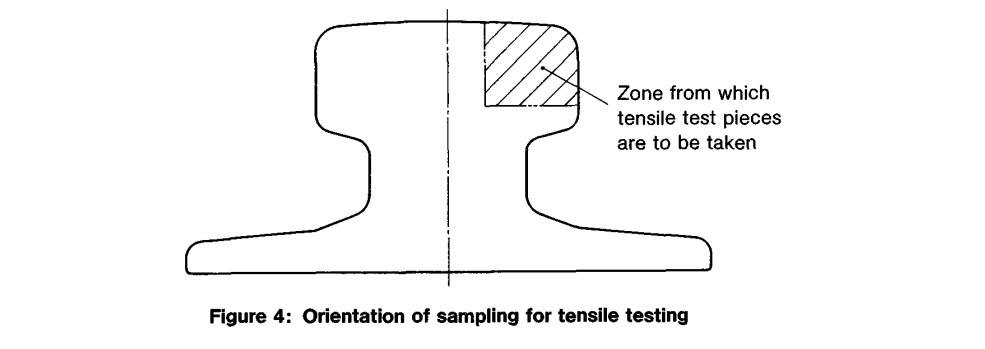
Figure 4 Orientation of sampling for tensile testing
Table 3 Tensile strength and chemical composition of steel

Form of supply

  • Crane rails shall be supplied in specified lengths, which shall be the subject of agreement.
  • The upper limit deviation for the crane rail length shall be 100 mm, lower values being the subject of agreement. The lower limit deviation is zero.

Other Requirements

  • Crane rails shall be free from internal and external defects that would likely impair their performance to a considerable degree.
  • Welded crane rails shall comply with the requirements specified in Stahl-Eisen-Betriebsblatt (Iron and steel instruction sheet) (SEB) 368 100.
  • The tolerances on crane travelling and crane trolley tracks and on welded rail joints shall be as specified in SEB 664 035.

Standards and other documents referred to

  • DIN 1080 Part 1
    Quantities, symbols and units used in civil engineering; principles
  • DIN 1080 Part 2
    Quantities, symbols and units used in civil engineering; statics
  • DIN 50049
    Inspection documents for the delivery of metallic products
  • ISO 1101:1983
    Technical drawings; geometrical tolerancing; tolerancing of form, orientation, location and run-out; generalities, definitions, symbols and indications on drawings
  • Stahl-Eisen-Betriebsblatt 368100
    Geschweißte Kranschienenstöße; technische Anforderungen
    (Welded crane rail joints; technical requirements)
  • Stahl-Eisen-Betriebsblatt 664 035
    Krane und Kranbahnen einschließlich geschweißter Kranschienenstöße;
    Toleranzen für das Fahrsystem Laufrad-Schiene
    (Cranes and rail crane tracks with welded crane rail joints; tolerances for running wheel tracks)

Other relevant standard and document

DIN 15 070
Cranes; design principles for track wheels

[1] Moissiadis, A.
Untersuchung der Beanspruchbarkeit von Kranschienen auf elastischer Bettung
(Analysis of the bearing capacity of crane rails installed on elastic bedding)
Dissertation, Ruhr-Universität Bochum, 1986.

Previous editions

DIN 536: 05.41
DIN 536 Part 1: 04.59, 12.74

Amendments

In comparison with the December 1974 edition, the following amendments have been made.

a) Rail type A 150 is included for the first time.
b) Additional dimensional and geometrical tolerances have been specified.
c) More information has been given with regard to section parameters.
d) The standard has been editorially revised.

Explanatory notes

It was originally intended to prepare a new series of standards on crane rails, but after many justified objections were raised at the draft stage, the project was terminated, and the decision was made to update the specifications of the present standard. To ensure interchangeability with crane rails complying with the previous edition, no changes were made to the principal dimensions.

Over time, crane systems have been modified, and new designs developed, which involve an increase in the load the wheel exerts on the rail and an improvement in the properties of the wheel material. In practice, this has meant that type A 120 rails suffered frequent fractures, particularly in the welded joints. Laboratory tests and analyses have shown that at the load levels currently involved, the strength of the welded joint zone falls below the fatigue strength at a stated number of cycles, i.e. the possibility of fracture cannot be ruled out.

To ensure the future performance of crane rails at these higher load levels, type A 150 rails have been specified here. The connecting dimensions for their baseplates correspond to those for type A 120 rails, so that no changes need to be made to the rail fixings when this type is incorporated into existing rail-wheel systems. However, changes will have to be made to the crane design, since the head of type A 150 rails is 45 mm higher than type A 120, which will have a negative impact on other features (e.g. required power supply).

The shape of the head was previously required to be flat, but is now to be slightly curved. Laboratory tests and practical experiments have shown that this causes the load to be applied more centrally and prevents an accumulation of stresses at the rail edges.

The dimensional and geometrical tolerances and section parameters have been specified in greater detail and brought into line with the design principles given in DIN 1080 Parts 1 and 2, which reflect the state of the art.

Other standards relating to crane rails are currently in preparation, these covering elastic bedding of crane rails, crane rail fixings, and sole plates.

International Patent Classification

B66C 7/00
E01B 25/00

Conclusion

DIN 536 Part 1 plays a crucial role in the global crane industry by defining the dimensions, section parameters and steel grades for A-series crane rails. These standardized rail profiles help engineers design reliable crane runway systems and ensure compatibility with crane wheel loads.

Today, DIN 536 crane rails such as A45, A65, A75, A100 and A120 are widely used in industrial plants, shipyards, ports and steel mills around the world.

When selecting crane rails for a project, engineers must consider factors such as crane capacity, wheel load, duty class and runway span. Choosing the correct crane rail standard ensures safe crane operation, longer rail service life and lower maintenance costs.

Understanding DIN 536 crane rail specifications is therefore essential for anyone involved in crane design, crane installation and industrial material handling systems.

Table of Contents

Related Resources

Scroll to Top

Contact Us Now