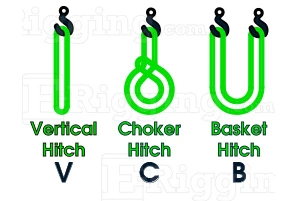
Choosing the correct sling hitch is one of the most important decisions in a lifting operation. The three most common hitch configurations—Vertical, Basket, and Choker—each offer different load capacities, stability characteristics, and applications.
Using the wrong hitch can reduce lifting capacity, damage the load, or create unsafe lifting conditions.
Overview of Sling Hitch Types
Vertical Hitch
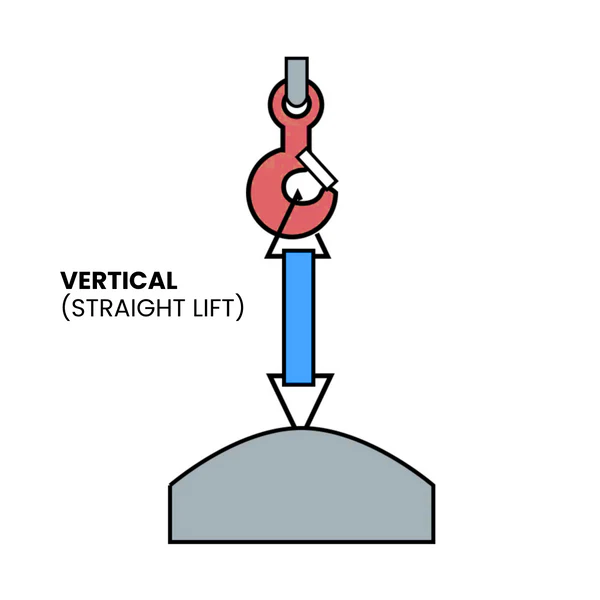
A vertical hitch uses a single sling leg attached directly between the lifting hook and the load.
How It Works
The sling supports the entire load in a straight vertical line.
Advantages
- Simple setup
- Full rated sling capacity
- Quick attachment and removal
- Ideal for loads with dedicated lifting points
Limitations
- Provides little load stability
- Load can rotate or tilt
- Entire load is carried by a single leg
Best Applications
- Machinery with lifting lugs
- Steel plates with lifting eyes
- Pumps, motors, and equipment with certified lifting points
Basket Hitch
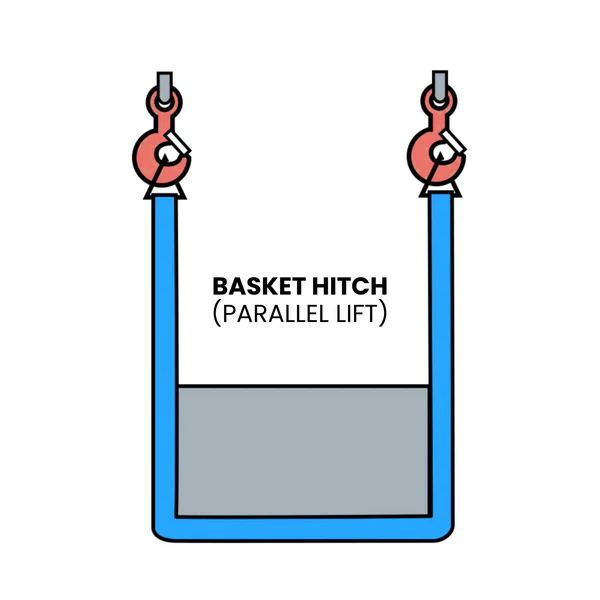
A basket hitch passes the sling underneath the load, with both ends attached to the hook.
How It Works
The load rests inside the sling loop, distributing weight across two sling legs.
Advantages
- Greater load stability
- Better load distribution
- Higher lifting capacity than a vertical hitch
- Reduced stress on the sling
Limitations
- Load must be balanced
- Sling angles affect capacity
- Load can slip if not properly secured
Best Applications
- Pipes and tubes
- Structural beams
- Pallets and crates
- Cylindrical equipment
Choker Hitch
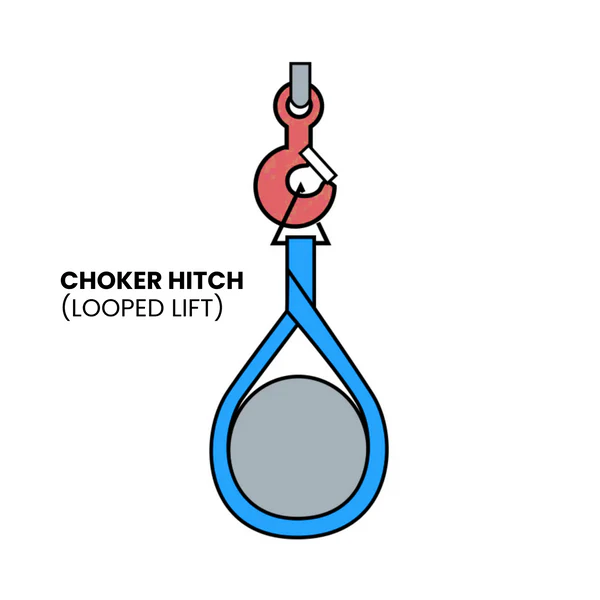
A choker hitch wraps around the load and passes one end of the sling through the other, creating a tightening loop.
How It Works
As the load is lifted, the sling tightens around it.
Advantages
- Excellent load control
- Helps prevent load shifting
- Useful when lifting points are unavailable
- Works well with irregular shapes
Limitations
- Reduced sling capacity
- Can damage delicate surfaces
- Generates concentrated pressure on the load
Best Applications
- Bundled materials
- Pipes
- Steel sections
- Logs and construction materials
Capacity Comparison
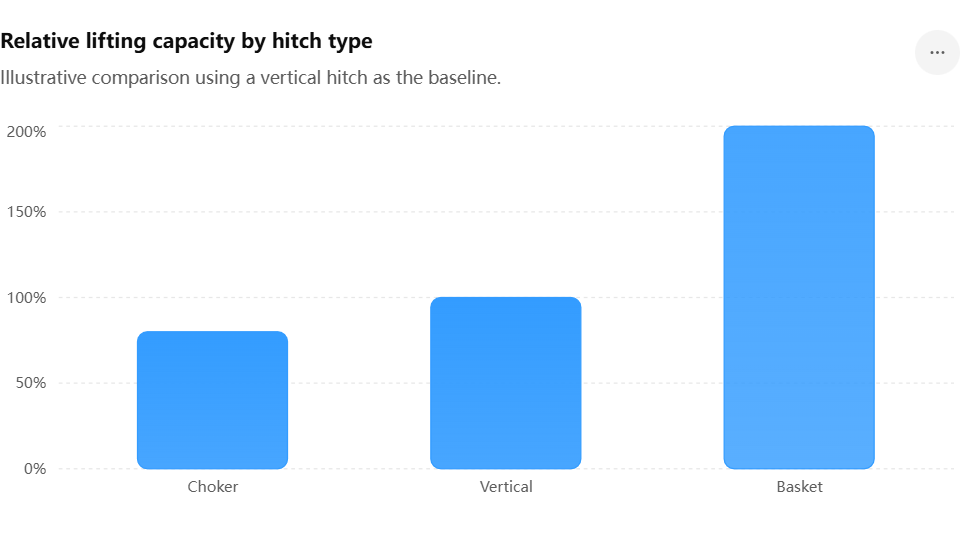
The actual capacity depends on sling type, angle, and manufacturer ratings, but generally:
Typical rule of thumb:
- Vertical Hitch = 100% of rated capacity
- Basket Hitch = Up to 200% of rated capacity (when load is balanced)
- Choker Hitch = Typically 75–80% of rated capacity
Always verify the manufacturer’s load chart before lifting.
Stability Comparison
| Hitch Type | Stability | Load Control | Capacity |
| Vertical | Fair | Fair | Standard |
| Basket | Excellent | Good | Highest |
| Choker | Good | Excellent | Reduced |
When to Choose Each Hitch
Choose a Vertical Hitch When:
- The load has engineered lifting points.
- Maximum rated capacity is needed.
- Load orientation is not critical.
Choose a Basket Hitch When:
- Stability is the top priority.
- The load can be supported from underneath.
- Higher lifting capacity is desired.
Choose a Choker Hitch When:
- No lifting lugs exist.
- The load must be secured against slipping.
- The load has an irregular shape.
Common Mistakes to Avoid
❌ Using a basket hitch on an unbalanced load.
❌ Forgetting that sling angle reduces capacity.
❌ Assuming a choker hitch retains full sling strength.
❌ Allowing sharp edges to contact the sling without protection.
❌ Using a vertical hitch when load stability is poor.
Quick Selection Guide
| Lifting Situation | Recommended Hitch |
| Equipment with lifting eyes | Vertical |
| Long pipe or beam | Basket |
| Bundled pipe or steel | Choker |
| Heavy balanced load | Basket |
| Irregular load without lifting points | Choker |
| Precision lift using engineered lifting lugs | Vertical |
Conclusion
There is no single “best” sling hitch for every lift:
- Vertical Hitch → Best for loads with dedicated lifting points.
- Basket Hitch → Best for maximum stability and lifting capacity.
- Choker Hitch → Best for gripping and controlling loads without lifting lugs.
For most general rigging operations, the basket hitch is often preferred because it offers the best combination of stability and capacity, while choker hitches excel when load security is the primary concern. Always follow the sling manufacturer’s rated capacities and applicable lifting standards before performing any lift.
FAQs About Sling Hitch
The basket hitch is generally the strongest sling configuration because the load is supported by two sling legs. Under ideal conditions, a basket hitch can provide up to twice the rated capacity of a vertical hitch.
However, actual capacity depends on:
- Sling type
- Sling angle
- Load balance
- Manufacturer's ratings
Always consult the sling load chart before lifting.
There is no universally safest hitch.
- Vertical Hitch: Safest when lifting from engineered lifting points.
- Basket Hitch: Safest for balanced loads requiring maximum stability.
- Choker Hitch: Safest when preventing load slippage is the primary concern.
The safest choice depends on the load and lifting conditions.
A choker hitch creates a tightening action around the load, causing:
- Additional stress on the sling
- Increased friction
- Concentrated loading at the choke point
As a result, most choker hitches are rated at only 75–80% of the sling's vertical capacity.
No.
A basket hitch works best when:
- The load is balanced
- The center of gravity is known
- The sling can remain securely positioned under the load
Unbalanced loads may shift, tilt, or slip out of the basket.
The primary advantage is load security.
The tightening action helps:
- Prevent load movement
- Control irregularly shaped loads
- Lift objects without dedicated lifting points
This makes choker hitches popular for pipe bundles, structural steel, and construction materials.
Generally, no.
A vertical hitch provides minimal resistance to rotation because the load is suspended from a single attachment point.
If rotation is a concern, consider:
- A basket hitch
- Multiple-leg slings
- Tag lines
- Spreader beams
Yes.
As the sling angle decreases from vertical, tension in the sling increases.
Common examples:
| Sling Angle | Capacity Reduction |
| 90° | 100% |
| 60° | 87% |
| 45° | 71% |
| 30° | 50% |
Low sling angles can dramatically reduce safe lifting capacity.
Yes, provided:
- The sling manufacturer permits choker use
- The load does not exceed the choker-rated capacity
- Proper thimbles and fittings are used when required
Always follow the manufacturer's recommendations.
It depends on the situation:
- Single pipe with balanced support → Basket Hitch
- Pipe bundle → Choker Hitch
- Pipe with lifting lugs → Vertical Hitch
For long pipes, two basket hitches are often used to improve stability.
A double-wrap choker hitch wraps around the load twice before choking.
Benefits include:
- Improved grip
- Reduced slipping
- Better load control
It is commonly used on smooth or slippery loads such as steel pipes.
Yes, but caution is required.
Sharp edges can:
- Cut the sling
- Abrade the fibers
- Significantly reduce sling life
Use edge protection whenever synthetic slings contact corners or rough surfaces.
Choose a basket hitch when:
- Maximum lifting capacity is required
- The load is balanced
- Load surfaces are delicate
- Minimal compression force is desired
Choose a choker hitch when:
- Load security is more important than capacity
- The load lacks lifting points
- The load could slip during lifting
In many cases, yes.
A properly rated sling can often be used as:
- A Vertical Hitch
- A Basket Hitch
- A Choker Hitch
However, the rated capacity changes for each configuration, so always refer to the sling tag and manufacturer's load chart.
Common standards include:
- ASME B30.9 – Slings
- OSHA Lifting Regulations
- Crosby Group Rigging Guidelines
- Lift-All Sling Usage Manuals
Always comply with local regulations and manufacturer instructions.
Consider the following:
- Does the load have lifting points?
- Is the load balanced?
- Is load rotation a concern?
- Could the load slip?
- What is the load weight?
- What sling angles will be used?
- What is the sling's rated capacity?
If stability and capacity are the priorities, choose a basket hitch. If gripping and load control are critical, choose a choker hitch. If the load has certified lifting lugs, a vertical hitch is often the simplest and most effective option.