A concrete mixer is a mechanical device that blends cement, aggregates, water, and admixtures to produce uniform concrete for construction projects. Unlike concrete mixer trucks designed for transportation, mixers serve as production equipment at batching plants or job sites. This comprehensive guide explores mixer types (forced vs gravity), working principles, capacity parameters, and practical applications across various construction scenarios.
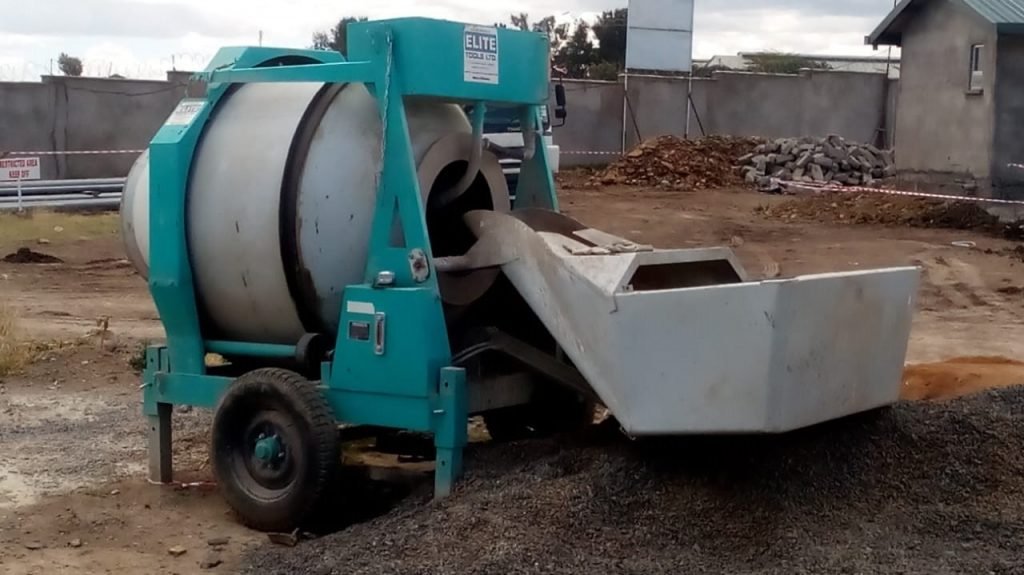
What is a Concrete Mixer?
A concrete mixer refers to a fixed or mobile mechanical device used on construction sites or in batching plants to mix raw concrete materials. Unlike a concrete mixer truck, which is primarily used for transporting and maintaining the uniformity of concrete, the core function of a concrete mixer is to thoroughly blend cement, aggregates (sand, stone), water, and admixtures according to specified ratios to produce a homogeneous concrete mixture.
Main Types and Features
1. Classification by Mixing Method
- Forced Mixer
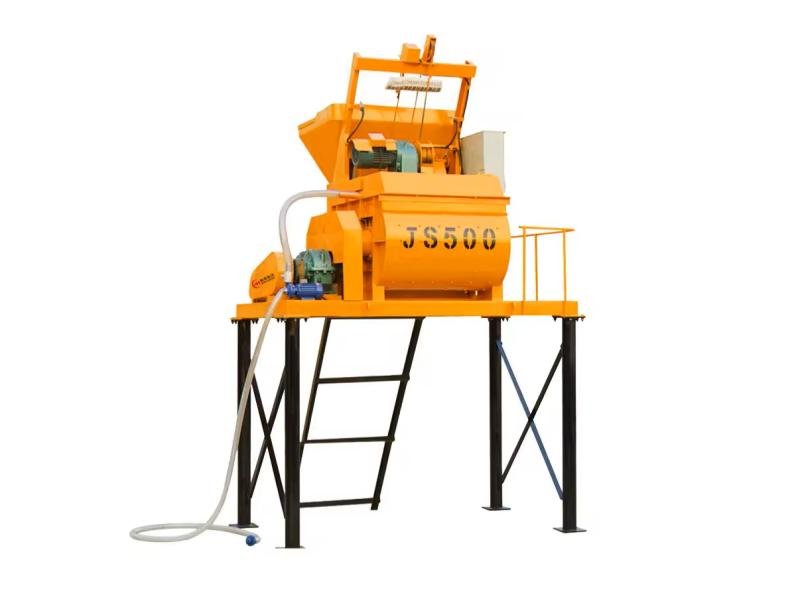
- Principle: Uses rotating blades inside a fixed mixing drum to forcibly shear and mix materials.
- Advantages: High mixing efficiency and uniformity, suitable for dry, semi-dry, and high-performance concrete.
- Common Models: Dual horizontal shaft (highest efficiency), planetary (precision mixing).
- Applications: Commercial concrete batching plants, precast component factories.
- Gravity Mixer (Tilting Drum Mixer)
- Principle: The mixing drum rotates, and internal lifting blades raise materials to a certain height before they fall and mix by gravity.
- Advantages: Simple structure, low energy consumption, easy maintenance.
- Disadvantages: Low mixing intensity, prone to segregation, suitable for plastic concrete.
- Common Models: Drum type (phased out), conical reverse discharge type (commonly used).
- Applications: Small construction sites, rural construction projects.
2. Classification by Installation Method
- Fixed Mixer: Installed in concrete batching plants or factories, with high capacity and automation.
- Mobile Mixer: Mounted on trailers or wheels, allowing flexible relocation, suitable for temporary projects.
Key Parameters
- Capacity: Common discharge capacities range from 0.5–6 cubic meters (e.g., JS500 indicates a discharge capacity of 0.5 m³).
- Power: Small machines (≤5.5 kW), large plant machines can reach hundreds of kilowatts.
- Mixing Time: Forced mixers typically take 30–60 seconds per batch, while gravity mixers require longer.
Workflow
- Batching: Raw materials such as aggregates, cement, and water are added according to the mix ratio (manually or automatically).
- Mixing: The motor starts, and blades or the mixing drum rotate to uniformly blend the materials.
- Discharge: Concrete is discharged through a discharge door or by reversing the mixing drum.
Differences from a Concrete Mixer Truck
| Feature | Concrete Mixer | Concrete Mixer Truck |
|---|---|---|
| Primary Function | Produces mixed concrete | Transports and maintains concrete uniformity |
| Mobility | Fixed or mobile but not for long-distance travel | Mounted on a truck chassis for long-distance transport |
| Typical Scenario | Batching plants, precast factories, construction sites | On the road from the batching plant to the construction site |
| Operational Focus | Mix ratio accuracy, mixing efficiency | Transport time control, preventing segregation |
Application Scenarios
- Construction Projects: On-site concrete mixing for foundations, beams, slabs, etc.
- Commercial Concrete Plants: Core equipment for continuous concrete production.
- Roads and Bridges: Mobile mixers for remote construction sites.
- Precast Component Factories: Producing high-strength or special-requirement concrete.
Precautions
- Mix Ratio Accuracy: Strict adherence to the designed mix ratio, especially for water and admixtures.
- Maintenance Points: Regularly clean accumulated material, inspect blade wear, and lubricate bearings.
- Safe Operation: Power off for maintenance after shutdown to prevent accidental motor startup.
- Environmental Requirements: Enclosed mixing buildings should be equipped with dust removal devices to control dust and noise.
Frequently Asked Questions About Concrete Mixers
I. Basic Concepts
Q1: What is the difference between a concrete mixer and a concrete mixer truck?
A: These are two commonly confused concepts:
- Concrete Mixer: A production device used to mix raw materials like cement, sand, stone, and water into concrete. Its main task is “mixing and manufacturing.”
- Concrete Mixer Truck: A transportation device used to keep premixed concrete uniform during transport and prevent setting. Its main task is “transport and preservation.”
Simple analogy: A mixer is the “kitchen,” while a mixer truck is the “thermal delivery bag.”
Q2: Which is better, a forced mixer or a gravity mixer?
A: There is no absolute “better” option—only suitability for different scenarios:
| Aspect | Forced Mixer | Gravity Mixer |
|---|---|---|
| Mixing Principle | Blades forcibly shear and mix materials | Materials fall freely and mix by gravity |
| Mixing Quality | High uniformity, suitable for various mix ratios | Effective for plastic concrete, prone to segregation |
| Energy Consumption | Higher | Lower |
| Maintenance Cost | Blades wear quickly, higher maintenance cost | Simple structure, lower maintenance cost |
| Best Application | Commercial concrete plants, high-strength concrete | Small construction sites, rural construction |
| Price | Higher | Lower |
Selection Advice:
- For high-quality, high-strength concrete → Choose a forced mixer.
- For limited budgets and small-scale projects → Choose a gravity mixer.
II. Operation and Usage
Q3: What is the optimal mixing time for concrete?
A: Mixing time depends on the mixer type and concrete characteristics:
| Mixer Type | Recommended Mixing Time | Notes |
|---|---|---|
| Forced Mixer | 30–60 seconds | Too short leads to uneven mixing; too long reduces efficiency |
| Gravity Mixer | 60–90 seconds | Requires longer to achieve uniformity |
| Special Cases | ||
| – High-strength concrete | Increase by 20–30% | Requires more thorough hydration |
| – Added admixtures | Extend by 10–15 seconds | Ensures even dispersion of admixtures |
| – Winter construction | Extend appropriately | Materials mix slower in low temperatures |
Judgment Criteria: Uniform concrete color, no dry clumps, consistent fluidity.
Q4: How to determine if the mixer capacity is suitable?
A: Follow the “70–80% Principle”:
- Rated Capacity: The mixer’s labeled capacity (e.g., JS500 is 0.5 m³).
- Actual Load: Should be 70–80% of the rated capacity.
- Example: For a 0.5 m³ mixer, the optimal load is 0.35–0.4 m³ per batch.
- Consequences of Overloading:
- Uneven mixing.
- Motor overload and damage.
- Accelerated wear and tear.
Capacity Selection Formula:
Required Mixer Capacity = Hourly Demand (m³/h) ÷ Number of Batches per Hour
Number of Batches per Hour = 60 minutes ÷ (Mixing Time + Loading/Unloading Time)
Q5: What safety precautions should be taken when operating a mixer?
A: Must-follow “Five Safety Rules”:
- Pre-Start Inspection:
- Ensure no personnel or debris are inside the drum.
- Check the lubrication system.
- Verify all bolts are tight.
- Prohibitions During Operation:
- Do not insert hands or tools into the mixing drum.
- Do not clean or repair while the machine is running.
- Avoid overloading.
- Electrical Safety:
- Ensure grounding protection is intact.
- Exercise extra caution during rainy conditions.
- Check cables for damage.
- Personal Protective Equipment (PPE):
- Wear a hard hat and dust mask.
- Wear anti-slip shoes.
- Tie up long hair.
- Emergency Procedures:
- Know the location of the emergency stop button.
- Develop an emergency response plan.
III. Troubleshooting
Q6: What are common mixer faults and how to handle them?
A: Quick Troubleshooting Guide:
| Fault Phenomenon | Possible Causes | Solutions |
|---|---|---|
| Motor Won’t Start | 1. Power failure 2. Thermal relay tripped 3. Button damaged | 1. Check power lines 2. Reset thermal relay 3. Replace button |
| Abnormal Noise | 1. Bearing damage 2. Loose blades 3. Foreign object entry | 1. Replace bearing 2. Tighten blades 3. Stop and clean |
| Poor Discharge | 1. Discharge door deformed 2. Low concrete slump 3. Hardened accumulated material | 1. Adjust or replace discharge door 2. Adjust mix ratio 3. Clean regularly |
| Leakage | 1. Worn seals 2. Excessive liner gap | 1. Replace seals 2. Adjust or replace liner |
| Uneven Mixing | 1. Severe blade wear 2. Overloading 3. Insufficient mixing time | 1. Replace blades 2. Reduce load 3. Extend mixing time |
Q7: When should blades be replaced due to wear?
A: Replacement Criteria—”Three Checks”:
- Check Thickness: Replace if the thinnest part of the blade is ≤ 1/3 of the original thickness.
- Check Shape: Replace if blades are bent or deformed, losing their original angle.
- Check Performance: Replace if mixing time significantly increases or concrete quality declines.
Replacement Tips:
- Replace blades in pairs to maintain balance.
- Use original or compatible specification blades.
- Test balance after replacement by running the mixer empty.
IV. Maintenance
Q8: What daily maintenance tasks are required for a mixer?
A: Tiered Maintenance Plan:
Daily Maintenance (Performed by the Operator):
- Before work: Run empty for 1–2 minutes, check for abnormalities.
- During work: Monitor for unusual sounds or vibrations.
- After work:
- Thoroughly clean the mixing drum.
- Remove external accumulated material.
- Check lubrication points.
Weekly Maintenance (Performed by a Mechanic):
- Inspect blade wear.
- Tighten all bolts.
- Check gearbox oil level.
- Clean motor heat sinks.
Monthly Maintenance (Performed by Professionals):
- Replace severely worn blades.
- Check electrical system insulation.
- Calibrate the batching system (if equipped).
Q9: How to store a mixer when not in use for a long time?
A: “Four-Step Storage Method”:
- Thorough Cleaning: Remove all concrete residues.
- Anti-Corrosion Treatment:
- Apply anti-rust oil to metal surfaces.
- Place desiccants inside the mixing drum.
- Key Part Protection:
- Cover the motor with waterproof cloth.
- Lubricate bearings with fresh oil.
- Storage Environment:
- Store in a dry, ventilated indoor area.
- Avoid direct contact with the ground (use pads or blocks).
V. Purchasing Advice
Q10: How to choose the right concrete mixer?
A: “Five-Step Selection Method”:
- Define Requirements:
- Project type (building, road, hydraulic).
- Concrete volume (total demand, peak demand).
- Concrete type (ordinary, high-strength, special).
- Determine Type:
- Large commercial plants → Dual horizontal shaft forced mixer.
- Small construction sites → Gravity or small forced mixer.
- Mobile needs → Trailer-mounted mixer.
- Evaluate Key Parameters:
- Discharge capacity (not loading capacity).
- Motor power (sufficient for starting torque).
- Production efficiency (m³/h).
- Compare Brands and Services:
- Leading brands: Sany, Zoomlion, LiuGong, etc.
- After-sales service network.
- Availability of spare parts.
- On-Site Inspection:
- Observe actual operation.
- Test ease of operation.
- Understand energy consumption.
Q11: Should I buy a new or used mixer?
A: Decision Comparison:
| Consideration | New Machine | Used Machine |
|---|---|---|
| Initial Investment | High (30–50% more expensive) | Low |
| Reliability | High, with warranty | Depends on previous usage |
| Energy Efficiency | Complies with latest standards | May have higher energy consumption |
| Technology | Latest advancements | May be outdated |
| Risk | Low | Potential hidden faults |
Used Machine Selection Tips: “Three Checks, Three Tests”
- Check Structure: Look for cracks or deformations.
- Check Wear: Inspect blade and liner wear.
- Check Records: Review maintenance logs.
- Test Empty Run: Listen for sounds, test vibrations.
- Test Under Load: Observe mixing effectiveness.
- Test Operations: Ensure all functions work properly.
Summary
Concrete mixers are the “heart” of concrete production, blending raw materials into uniform concrete through mechanical forced or gravity mixing. The choice between forced or gravity mixing, fixed or mobile types should be based on project requirements (concrete type, capacity), site conditions, and cost. For specific model selection or troubleshooting, feel free to ask further questions!