What is Concrete Slump?
Concrete slump refers to the degree to which freshly mixed concrete subsides or spreads under its own weight. It is a simple, rapid on-site test used to measure the fluidity and workability of concrete.
Simply put, the slump test assesses “how thin or thick the concrete is.” A higher slump value indicates that the concrete is more fluid and workable, while a lower slump value indicates that the concrete is stiffer and less fluid.
Why is Slump So Important?
It directly relates to the constructability and final quality of concrete:
- Constructability: Concrete with an appropriate slump is easy to pump, pour, and vibrate, ensuring it fills every corner of the formwork.
- Strength and Durability: If the slump is too high (too thin), it may indicate excessive water content, which can reduce strength, increase cracking, and cause water seepage after hardening. If the slump is too low (too dry), it becomes difficult to compact, leading to defects like honeycombing and voids.
- Quality Control: It serves as the first checkpoint for quickly determining whether a batch of concrete meets the design mix requirements on-site.
How is the Slump Test Conducted? (Standard Method)
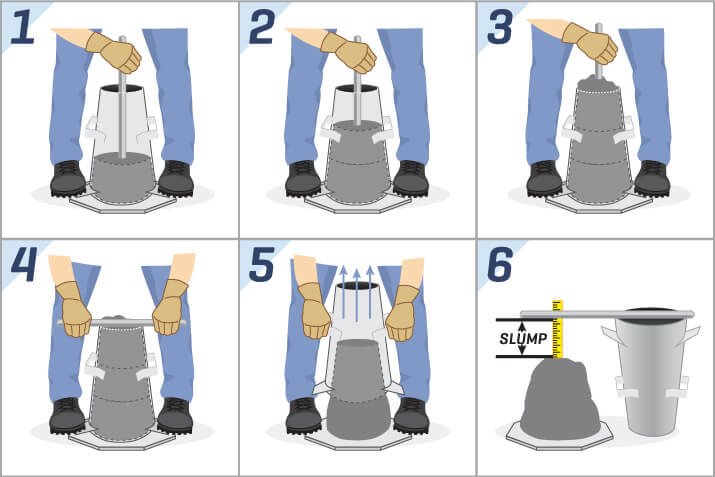
The most commonly used method is the slump cone test, which requires simple tools:
- Tools: A conical mold (slump cone) with a top diameter of 100 mm, bottom diameter of 200 mm, and height of 300 mm; a tamping rod; a ruler; and a flat plate.
- Procedure:
- Place the slump cone on a flat, moistened plate.
- Fill the cone with concrete in three layers, tamping each layer evenly 25 times with the rod.
- After filling and leveling, vertically and slowly lift the slump cone.
- Once the concrete is no longer confined by the cone, it will subside under its own weight.
- Measurement:
- Measure the height difference (in mm) between the cone height (300 mm) and the highest point of the slumped concrete. This difference is the slump value.
Classification of Slump and Typical Applications
Based on the slump value, concrete can be roughly categorized as follows:
| Slump Range (mm) | Consistency Description | Typical Applications |
|---|---|---|
| 10 – 40 | Low plasticity / Dry and stiff | Precast concrete components, foundation bedding, pavements |
| 50 – 90 | Plastic (most commonly used) | Most cast-in-place structures, such as beams, slabs, columns, foundations |
| 100 – 150 | Fluid | Pumped concrete, densely reinforced structures |
| ≥ 160 | Highly fluid (self-leveling) | High-flow concrete, self-compacting concrete, underwater pouring |
Main Factors Affecting Slump
- Water Content: The most sensitive factor; increasing water content significantly raises slump.
- Cement Type and Amount: Higher cement content generally reduces slump (though more paste can improve fluidity, making the relationship complex).
- Aggregates: Improper sand ratio (proportion of sand to total aggregates), small aggregate size, or excessive needle-shaped or flaky particles can reduce slump.
- Admixtures: Water reducers are key tools for adjusting slump, as they significantly improve fluidity without increasing water content.
- Time and Temperature: Concrete becomes stiffer over time after mixing (slump loss), and this loss accelerates in high temperatures.
Limitations of Slump Testing
While the slump test is simple, it is primarily suitable for plastic concrete. For extremely dry (slump near 0) or extremely fluid (self-compacting concrete) mixes, other testing methods (such as the Vebe consistometer or flow table test) are needed to evaluate workability.
Summary
Concrete slump is an intuitive “fluidity scale” that bridges the gap between laboratory mix design and on-site construction. Controlling slump is the first step in ensuring that concrete is easy to work with and ultimately durable. For different construction methods (such as manual pouring, pumping, or slip-form paving), concrete with an appropriate slump range must be selected.